 Agent Governance Toolkit overview
The Agent Governance Toolkit is Microsoft's open-source layer that sits between an agent deciding to call a tool and the tool running, so a rule, not a prompt, decides what is allowed.
Last updated: 14 Oct, 2026 · Agent Governance Toolkit 4.1.0
An agent that can take actions can be talked into the wrong one. A message that says ignore the rules and close the account is still text to a model, and if the account-closing tool is wired up, the model can call it. Governance puts a gate in front of that call: the agent still decides, but a policy you control gets the final say, and every verdict is written down.
The six pillars
The toolkit advertises six areas. This course teaches the ones that run locally with no key, and names, in each lesson, where the Public Preview does not yet deliver.
- Policy decides whether an action may run, in Python or in a YAML file.
- Audit records every decision in a tamper-evident log.
- Identity gives an agent a cryptographic name it can prove, and a way to delegate without handing over more than it holds.
- MCP governance checks the tools an agent reaches over the Model Context Protocol, and what they send back.
- Sandboxing and reliability run an action in a container and add circuit breakers. The policy parts run here; the container parts need Docker and are shown, not run.
- The mesh ties many agents together. The course uses its identity and audit pieces and leaves the rest.
What you will build
One example grows through the whole course: a support agent for a shop. It starts as a few lines of plain Python that can refund an order, check a status, or close an account. By the end it has a gate on every tool call, a policy in a file, a signed identity, and an audit trail you can prove was not edited. Along the way it also governs a tool server over MCP. Nothing it does needs a model key.
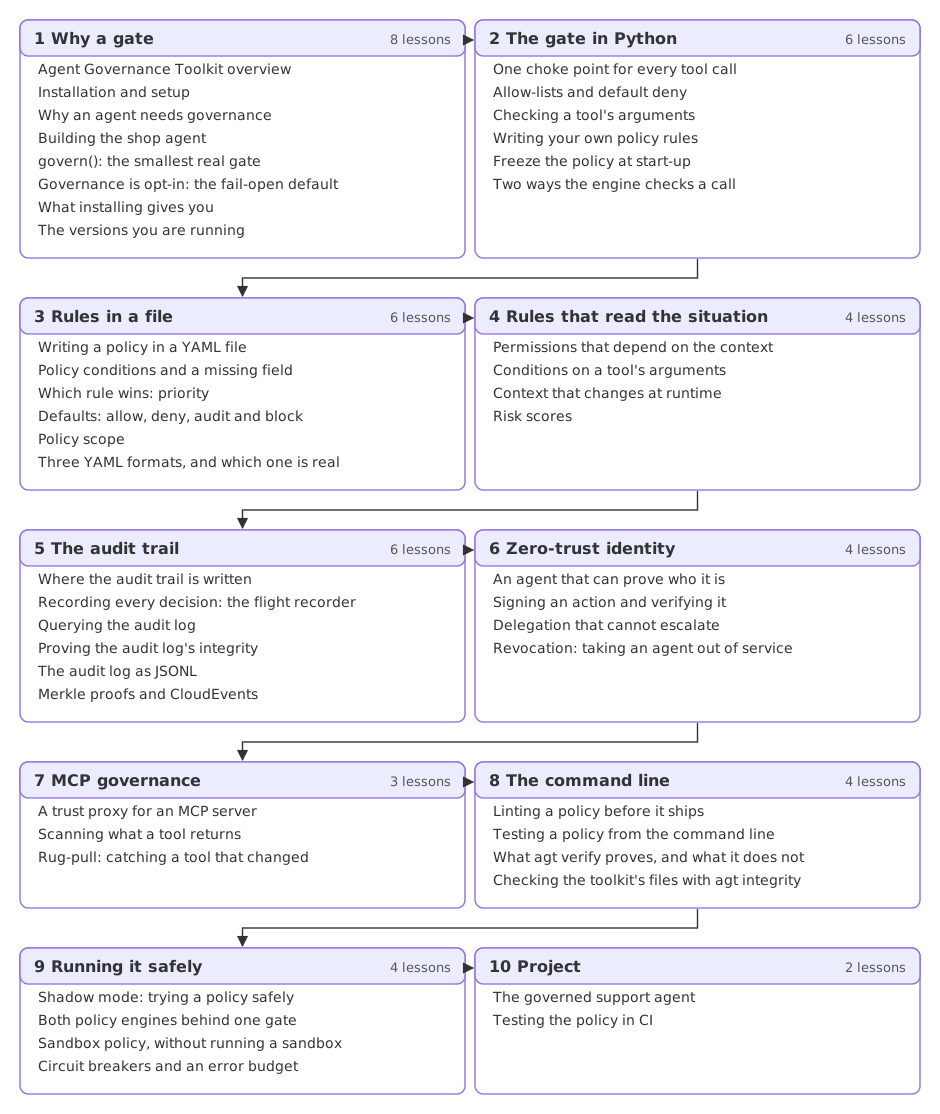
The ten parts
Related
- Next: Installation and setup
- Reference: Agent Governance Toolkit documentation
Every expert started right here.