
One model call or three
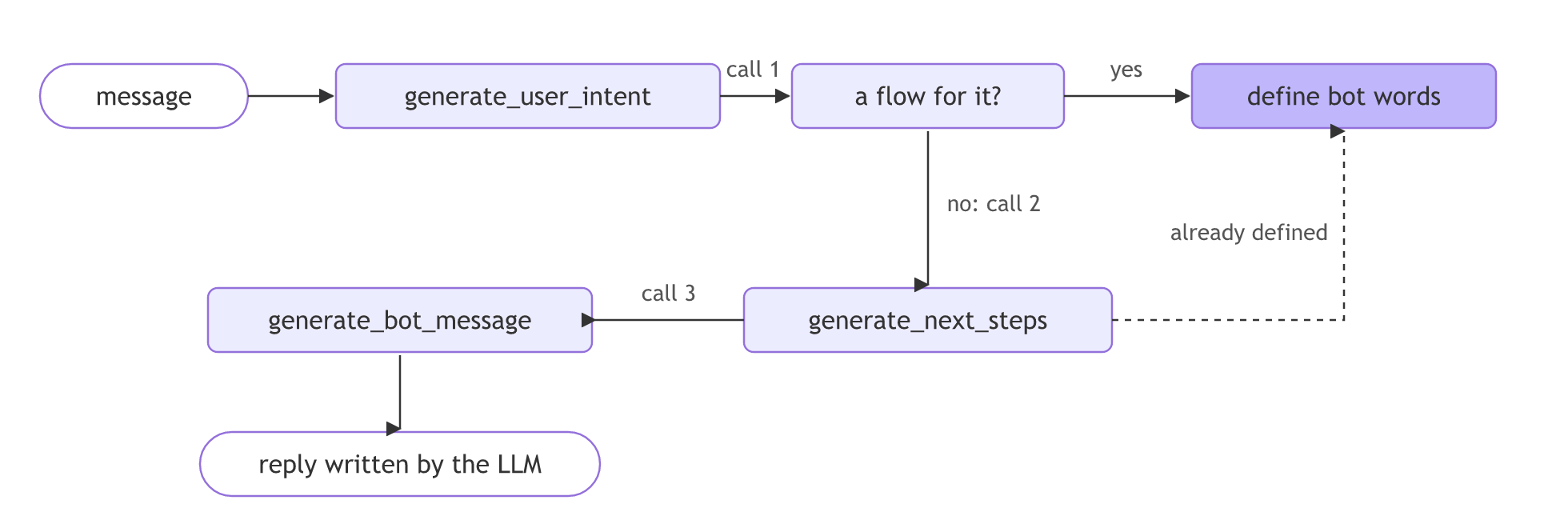
A turn in NeMo Guardrails costs one model call when the message matches a flow whose bot words are defined, and three calls when it matches no flow: the intent, the next step and the bot message.
Last updated: 30 Sep, 2026 · NeMo Guardrails 0.24.1
The video says the dialog rails save tokens: we don't want our large language model to even think about hi and bye. rails.explain() can count exactly how many calls a message costs.
Syntax:
rails.generate(messages=[...])
[call.task for call in rails.explain().llm_calls]   # the task name of every model call
The three tasks
generate_user_intent: which intent is this message? Always runs when there is Colang.generate_next_steps: no flow matched, so what should the bot do? Skipped when a flow decides.generate_bot_message: the words, when nodefine botgives them.
- written in define user and define bot
- written in define user and define bot
View the code here
define user ask off topic
  "tell me a joke"
  "what is the capital of france"
  "write me a poem"
  "what is 2 plus 2"
  "what should I eat for dinner"
  "who won the game yesterday"
  "recommend a movie"
  "what is the weather like"

define bot refuse off topic
  "I'm an Enterprise IT Assistant focused on Kubernetes, Intel hardware, and networking. I can't help with that — but ask me anything technical!"

define flow handle off topic
  user ask off topic
  bot refuse off topic
  stop
from nemoguardrails.embeddings.index import EmbeddingsIndex


class EveryExample(EmbeddingsIndex):
    """Hands the model every example instead of the closest few."""

    def __init__(self, **kwargs):
        self.items = []

    async def add_items(self, items):
        self.items.extend(items)

    async def build(self):
        pass

    async def search(self, text, max_results=5, threshold=None):
        return self.items


def init(app):
    app.register_embedding_search_provider("every_example", EveryExample)
models:
  - type: main
    engine: openai
    model: openai/gpt-oss-20b
    api_key_env_var: GROQ_API_KEY
    parameters:
      base_url: https://api.groq.com/openai/v1
      temperature: 0

instructions:
  - type: general
    content: |
      You are an Enterprise IT Assistant specialising in Kubernetes,
      Intel hardware, and enterprise networking.
      Only answer questions about these topics.
      Answer in one or two short sentences.

core:
  embedding_search_provider:
    name: every_example
prompts:
  - task: generate_user_intent
    content: |-
      """
      {{ general_instructions }}
      """

      # This is how a conversation between a user and the bot can go:
      {{ sample_conversation | verbose_v1 }}

      # This is how the user talks:
      {{ examples | verbose_v1 }}

      # This is the current conversation between the user and the bot:
      {{ sample_conversation | first_turns(2) | verbose_v1 }}
      {{ history | colang | verbose_v1 }}

      Do not answer the user. Reply with one line: the user intent of the last message.
      Use an intent from the examples when one fits, otherwise write a new short intent.
    output_parser: verbose_v1
Counting calls for two messages
The runs on this page use openai/gpt-oss-20b, the smaller gpt-oss model on the same free Groq key, in the model line of config.yml. This config makes several model calls per message, and the smaller model spends fewer of the key's daily tokens. Put openai/gpt-oss-120b back in that line to use the course's main model.
from nemoguardrails import LLMRails, RailsConfig

rails = LLMRails(RailsConfig.from_path("."))


for message in ["Tell me a joke", "What is a Kubernetes DaemonSet?"]:
    rails.generate(messages=[{"role": "user", "content": message}])
print(message, "->", [call.task for call in rails.explain().llm_calls])Tell me a joke -> ['generate_user_intent'] What is a Kubernetes DaemonSet? -> ['generate_user_intent', 'generate_next_steps', 'generate_bot_message']
What the counts mean
- The joke cost one call. The flow decided the next step, and
define botheld the words. - The DaemonSet question cost three. No flow matched, so the model was asked what to do, then what to say.
Matched vs unmatched
| Matched flow with define bot | No matching flow | |
|---|---|---|
| Model calls | 1 | 3 |
| Who writes the reply | You, in rails.co | The model |
| Cost of an off-topic message | One short classification | A full answer |
Where this matters
- Greetings and farewells, which the video answers with fixed words in Dialog rails.
- Estimating the token cost of a config before it goes live.
Related
- Previous: The prompt behind the intent
- Next: Input rails
- Reference: How it works
- Add
"Tell me a joke"twice in the loop and check whether the second costs the same. - Print
call.total_tokensnext to each task.
Slow is fine. Stopping is the only problem.