Foundations
The goal for the first month is to be a competent backend engineer who understands how LLMs actually work. Week 1 makes your Python production grade, week 2 covers data and APIs, week 3 the tools every engineering team uses, and week 4 what happens inside a model when you call it. The month ends with a Document Q&A API: a tested, Dockerised service on GitHub that someone else can run.
 Python for AI
 Claude Code
 LLM Fundamentals
LLM Engineering
This month is about building LLM features that are reliable, not demos, and proving it with evals. You learn to steer a model with prompts and schemas, to retrieve the right passages from a large corpus, to ground answers in citations and refuse when nothing fits, and to measure all of it on a golden dataset. The project is an enterprise RAG assistant with an eval dashboard that shows accuracy before and after tuning.
LLM Fundamentals LangChain
 LlamaIndex
 LangGraph
 RAGAS
RAGASAgentic AI
This month you learn to design agents that take actions safely inside real workflows. Week 1 is the agent loop, tool design and memory; week 2 the frameworks: LangGraph, Deep Agents and the OpenAI Agents SDK; week 3 MCP, context engineering and human approval; week 4 guardrails, permissions and limits. The project is an ops workflow agent that reads tickets, queries a database and drafts actions, with a human approval gate and full trace logging.
LangChain LangMemLangGraph
 Deep Agents
 OpenAI Agents SDK
 Model Context Protocol
 NeMo Guardrails
Production & Deployment
From here the roadmap is about becoming deployable. This month's goal is to ship an AI system that stays up, stays cheap and stays observable. Week 1 is serving and infrastructure, week 2 the delivery pipeline, week 3 observability, and week 4 the model gateway and scale. The project puts your month 3 agent on a cloud with CI/CD, tracing, a cost dashboard and a gateway that falls back to another model.
LangGraphClaude CodeRAGASLangChainEnterprise Integration
This month is about making AI work with the systems, data and rules a real company already has. Week 1 is identity and access, week 2 getting data out of the client's systems and keeping it fresh, week 3 security and compliance, and week 4 the ways a client may require you to deploy. The project is a secure enterprise copilot: RAG with SSO, per-user permissions and an audit trail, deployable in a private VPC with an open-weight fallback.
LlamaIndexNeMo GuardrailsForward deployed
6 stages, 12 frameworks and 6 projects. Finish them and you will have shipped the kind of systems these teams hire for, with the lessons to back every one.
Browse all frameworks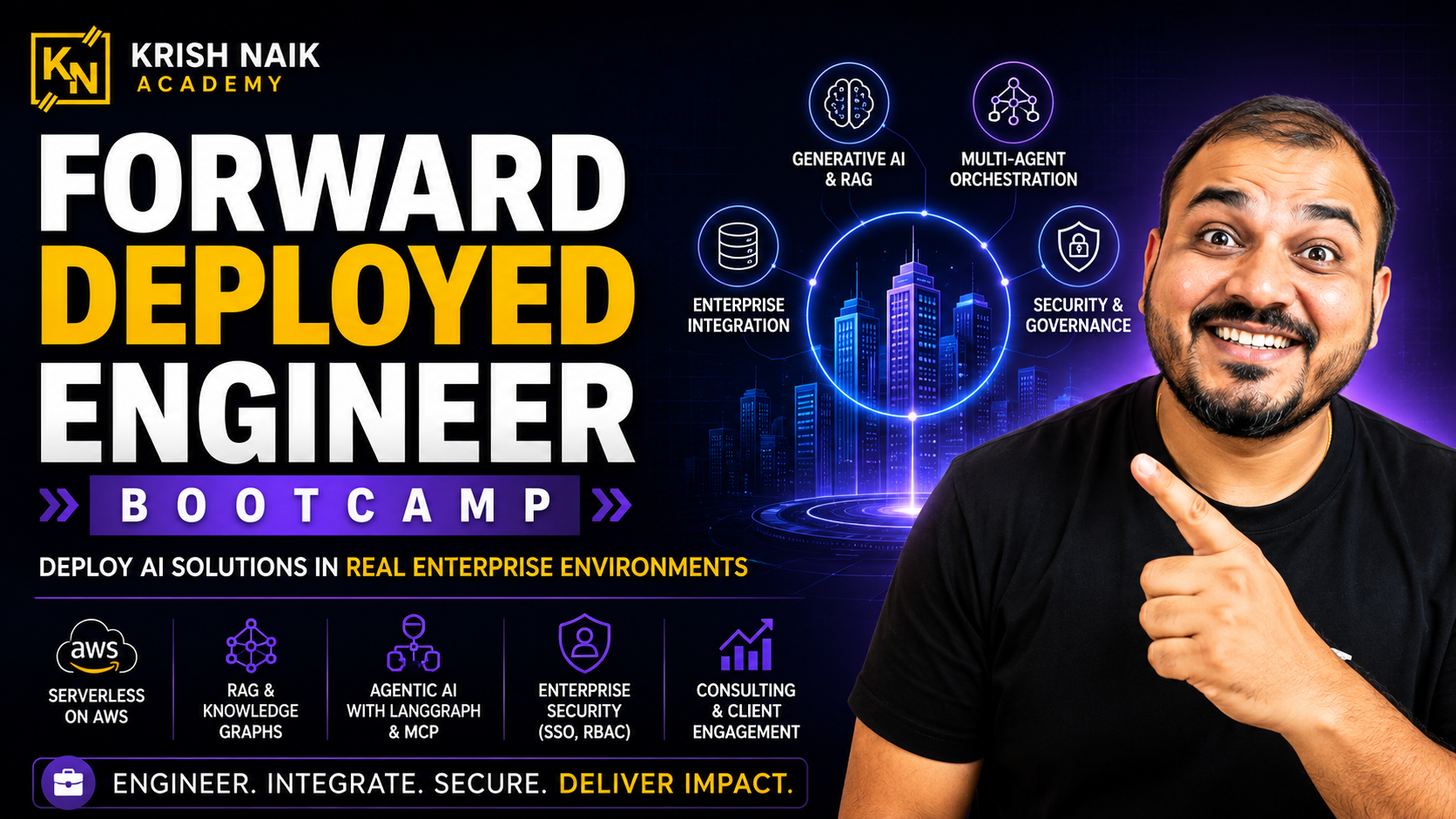
AI Forward Deployed Engineer Bootcamp
Everything in this roadmap, taught live by Krish Naik and industry mentors: compressed, project-driven and built around real client scenarios like the NovaSure case study.
- Live classes and recordings
- End-to-end FDE capstone project
- Mentorship and doubt-clearing
- Interview and career guidance
Questions about this roadmap
What does an AI forward deployed engineer do?
They work inside a client's business to get an AI system from idea to production and keep it there. Palantir created the role, sending engineers to customer sites to make its software work on real problems. OpenAI, Anthropic, Scale AI, Databricks and Cohere now hire forward deployed engineers for the same reason: a model only creates value once someone connects it to the client's data, systems, security rules and people. Day to day that means discovery and scoping, building RAG and agents, deploying them, and reporting the result in the client's own numbers.
How is it different from an ML engineer, a data scientist or a solutions engineer?
An ML engineer trains, tunes and serves models and is judged on model quality and infrastructure. A data scientist analyses data and builds models to answer questions, and is judged on insight. A solutions engineer supports the sale with demos and technical answers, and usually hands off once the contract is signed. A forward deployed engineer builds with existing models, works on site with the client after the sale, writes production code, and is judged on whether a business KPI moved, such as days to settle a claim or tickets resolved per hour.
How long does the roadmap take?
Six months at 15 to 20 hours a week, one stage per month. A typical week is about 5 hours of learning, 8 hours of building, 2 hours of writing about what you built, 2 hours with the community, and 1 to 2 hours reviewing someone else's work or your own. Each month ends with one portfolio project, so you finish with six projects and a client capstone.
Why do some stops say upcoming?
This roadmap follows the full bootcamp curriculum, and some tools on it do not have a course on the site yet: SQL, Git, Docker, Kubernetes, FastAPI, cloud and Terraform, vector databases, Langfuse, the LiteLLM gateway, vLLM, enterprise connectors and the consulting weeks among them. Those stops are shown so you can see the whole path, but they do not link anywhere yet. Learn them from the official docs or in the bootcamp's live classes, and mark each one done by hand. A stop opens in the same place when its course is published.
Is there a live bootcamp that follows this roadmap?
Yes. The AI Forward Deployed Engineer Bootcamp follows this curriculum month by month, with live classes, weekly builds, reviews and the client capstone. It starts on 4 October 2026. Details and enrolment are at krishnaik.in/liveclass2/Forward_Deployed_Engineer.
Do I need an API key or a paid model account?
For the courses, a free Groq key is enough: it runs the chat model in Python for AI, LLM Fundamentals, LangChain, LangGraph, MCP, NeMo Guardrails and RAGAS, and the setup lesson of each course shows how to get it. A few lessons also use a free Gemini key for embeddings. The LlamaIndex and OpenAI Agents SDK lessons run on a local embedding model and a stand-in model you write, so they need no key. The Claude Code stops are the exception: Claude Code needs a Claude subscription or an Anthropic API key.
Can I start this roadmap as a beginner?
Yes, with one extra step. Month 1 starts at production Python: classes, Pydantic, async and pytest. If you have not written Python before, take lessons 1 to 19 of the Python for AI course first, from variables to error handling. After that, every month assumes only the months before it.