 Deep Agents overview
Deep Agents is an open-source Python library from LangChain that builds agents able to plan a task, keep notes in files, hand parts of the work to helper agents and ask a person before a risky step.
Last updated: 29 Sep, 2026 · Deep Agents 0.7
Shallow agents and the ReAct loop
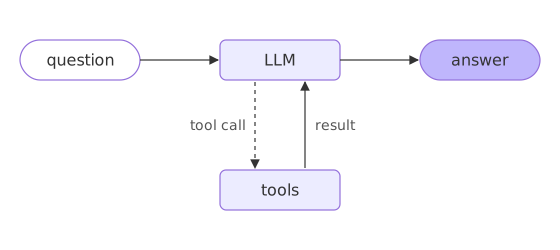
The crash course starts from the agent you already know. A question goes to an LLM, the LLM acts as the brain and decides whether to answer or call a tool, such as a weather API for the temperature in Paris, and the tool's result becomes the answer. The video calls this a shallow agent: the request flows straight through to an output. A ReAct agent improves on it by looping: the LLM can call many tools, one after another, and reads each result before deciding the next step. Both are still an LLM plus tools in a loop. There is no explicit plan, no place to keep large notes, and a complex question such as "find today's AI news and how it relates to economics and physics" is never broken into smaller questions.
TodoListMiddleware, and the agent also no longer ships a long built-in system prompt. The pages follow 0.7 and say where the video differs.Planning, subagents, a system prompt and a file system
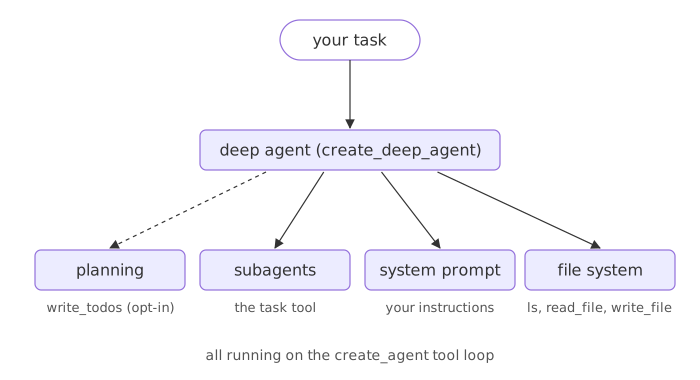
A deep agent keeps that loop and adds four parts. The video names them with Claude Code, OpenAI's deep research and Manus as the examples: a planning tool that turns the request into a to-do list, subagents that each take one item of work, a detailed system prompt that says how the agent behaves, and a file system where the agent and its subagents keep notes too large for the conversation.
What the deepagents package gives you
deepagents is a standalone library built on LangChain's agent building blocks, and it runs on LangGraph, which gives it saved state, streaming and pauses for a person. One function, create_deep_agent, returns an agent that already has file tools (ls, read_file, write_file, edit_file, delete, glob, grep), a task tool for subagents, automatic summarization of long conversations, and a place for your own tools and instructions. The documentation calls this an agent harness: the same tool loop as other agent frameworks, with the pieces that long, multi-step jobs need already attached. It is MIT-licensed, and this course uses version 0.7.19.
The video compares it with the Claude Agent SDK, the harness under Claude Code. Both plan, spawn subagents, manage context and support skills, hooks and MCP. The difference is where they run: the Claude Agent SDK is built around Claude models and its own runtime, while Deep Agents is open source on LangChain and LangGraph and works with any chat model that can call tools, including OpenAI, Gemini, Groq and local models.
The Paris trip planner you build
The crash course explains planning with a trip: book a holiday in Paris, three nights and four days, for 100,000 rupees. This course builds that agent. It starts as one tool that searches a small travel catalog. Lesson by lesson it gains a to-do list, files for its notes, memory of what the traveller likes, a packing skill, two helper subagents, and a pause before it spends money on a booking. In the last lessons it plans the whole trip on its own and writes an itinerary like this one, copied from its captured run on Groq:
Day 1: Arrive in Paris, check‑in at Hotel Lumiere, enjoy a free Montmartre walking tour, dinner at a local bistro.
Day 2: Visit the Eiffel Tower summit (3,100 ₹), take a Seine river cruise (1,500 ₹), dinner.
Day 3: Explore the Louvre Museum (2,000 ₹), take a Versailles day‑trip (2,600 ₹), dinner.
Day 4: Check‑out and fly back to Delhi.

## Cost Table
- Flight (Delhi → Paris → Delhi): 42,000 ₹
- Hotel Lumiere (3 nights @ 7,500 ₹/night): 22,500 ₹
- Food (3,000 ₹ per day × 4 days): 12,000 ₹
- Sights:
  - Eiffel Tower summit: 3,100 ₹
  - Louvre Museum: 2,000 ₹
  - Seine river cruise: 1,500 ₹
  - Versailles day‑trip: 2,600 ₹
  - Montmartre walking tour: free
  - **Total sights:** 9,200 ₹

**Grand Total:** 85,700 ₹
The full run, with its to-do list and the booking it waits to confirm, is in Trip planner: the finished deep agent. Every example runs on Groq's free tier.
Jobs that suit a deep agent
- Research and planning jobs that take many steps and more notes than fit in one prompt.
- Coding and data assistants that read, write and edit files, like Claude Code does.
- Any agent that should split work between specialists and ask a person before an action that costs money or cannot be undone.
Python and background knowledge
- Python 3.11 or later.
- Comfort with functions, dictionaries and pip. The LangChain course helps but is not required: each lesson explains the pieces it uses.
Related
- Next: Installation and setup
- Reference: Deep Agents overview
Every expert started right here.