
1
Curious builder0 XP earned · 300 to level 2
0 daysFinish a lesson to begin
Badge collection0 of 6 unlocked
51 small wins to finish your pathNext question →
What is the KV cache? Why is it needed, and how do you calculate its memory?
30-second answerSay your answer out loud first, then reveal.
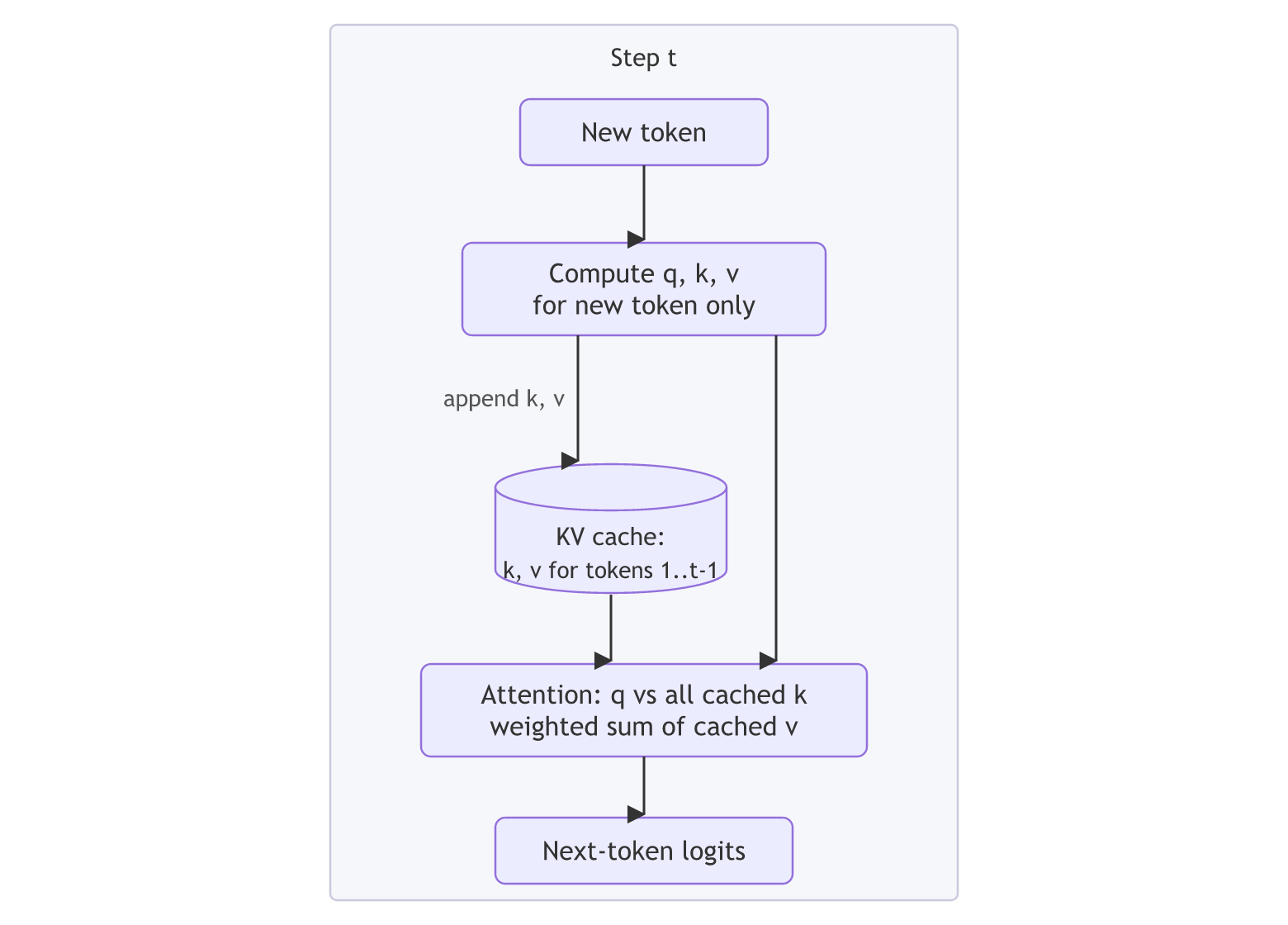
Memory formula
KV bytes per token = 2 (K and V) × n_layers × n_kv_heads × head_dim × bytes_per_value
KV total = per_token × context_length × batch_size (concurrent sequences)
Worked example: a 70B Llama-style model with 80 layers, 8 KV heads (GQA), head_dim 128, FP16 (2 bytes):
- Per token: 2 × 80 × 8 × 128 × 2 = 327,680 bytes ≈ 0.33 MB
- One 8K-token sequence: ≈ 2.7 GB
- 32 concurrent 8K sequences: ≈ 86 GB, on top of ~140 GB of FP16 weights.
- Without GQA (64 KV heads) it would be 8x larger, about 690 GB, which is impractical.
Ways to reduce KV memory
- GQA / MQA / MLA (fewer or compressed KV heads).
- KV cache quantization (FP8 / INT8).
- PagedAttention: allocate in blocks to avoid fragmentation and waste (Q33).
- Sliding-window attention for some layers (bounded cache).
- Prefix caching: share the cache for common prompt prefixes across requests.
Interview tip. Being able to do this calculation quickly is a strong signal for LLM infra and FDE roles.
Related
Slow is fine. Stopping is the only problem.