
1
Curious builder0 XP earned · 300 to level 2
0 daysFinish a lesson to begin
Badge collection0 of 6 unlocked
51 small wins to finish your pathNext question →
What is RAG, and why do we need it?
30-second answerSay your answer out loud first, then reveal.
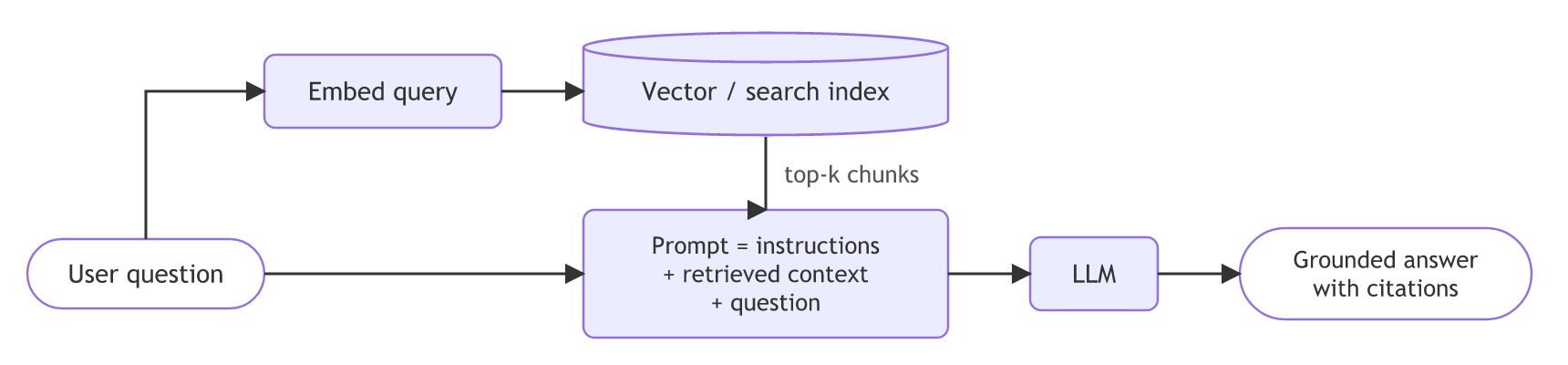
Why not just use the LLM?
- Knowledge cutoff: the model doesn't know last week's policy change.
- Private data: it never saw your company wiki, contracts or tickets.
- Hallucination: when unsure, LLMs produce fluent but wrong answers. Supplying the source text and instructing the model to answer from it reduces this considerably.
- Traceability: you can show which document an answer came from, which matters in enterprise, legal and medical settings.
- Cheap updates: update the index, not the model.
Origin: the term comes from Lewis et al. (2020, Facebook AI), which combined a retriever and a generator trained jointly. Today "RAG" usually means the simpler pattern of an off-the-shelf retriever plus a prompted LLM.
Example. An HR bot answering "How many casual leaves do I get?" retrieves the relevant section of the leave policy PDF and answers "12 days per year (Leave Policy §3.2)."
Common mistakes
- Saying RAG "trains the model on your data." It doesn't change model weights at all.
- Thinking RAG eliminates hallucination. It reduces it. The model can still ignore or misread the context.
Follow-ups to expect
- When would you fine-tune instead? (See Q12.)
- What are the main failure points? (See Q14.)
Related
Little by little, you're building something great.