
1
Curious builder0 XP earned · 300 to level 2
0 daysFinish a lesson to begin
Badge collection0 of 6 unlocked
51 small wins to finish your pathNext question →
How do you handle tables and structured data in RAG?
30-second answerSay your answer out loud first, then reveal.
For tables inside documents
- Extract with structure (layout-aware parsers); store as Markdown or HTML so rows and columns survive.
- Keep headers with data. If you split a large table, repeat the header row in each piece.
- Embed a summary, return the table: an LLM describes the table ("Quarterly revenue by region for FY2026, columns: ...") and that description gets embedded. The full table is passed to the LLM on retrieval (a multi-vector pattern).
- Row-level chunks for lookup tables: each row becomes "Product: X, Price: Y, Warranty: Z".
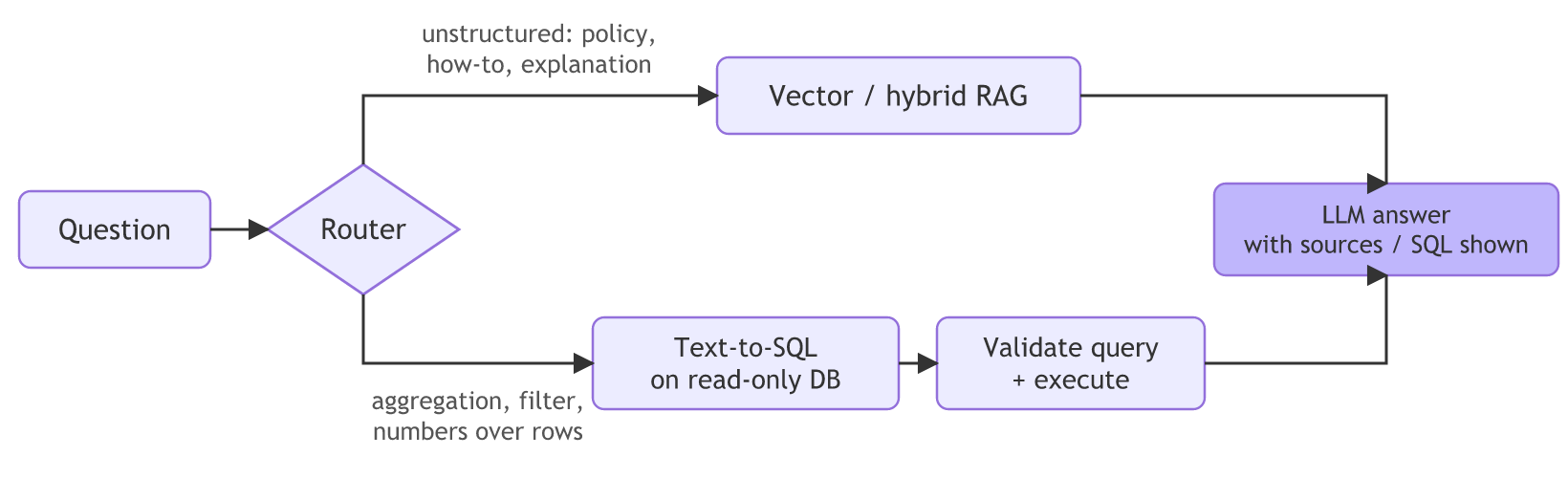
For databases / large structured data: text-to-SQL
- Provide the schema with column descriptions and example values; few-shot examples.
- Safety: read-only credentials, query validation, row limits, timeouts, no DDL/DML.
- Show the generated SQL or the source rows for transparency.
Why vector search fails here: "What's the average order value in Maharashtra last month?" needs filtering and arithmetic over thousands of rows. No top-k retrieval of chunks can compute that correctly.
Related
Slow is fine. Stopping is the only problem.