
1
Curious builder0 XP earned · 300 to level 2
0 daysFinish a lesson to begin
Badge collection0 of 6 unlocked
51 small wins to finish your pathNext question →
Design an evaluation platform for an organisation with 20 LLM-powered features built by different teams.
30-second answerSay your answer out loud first, then reveal.
Key design points
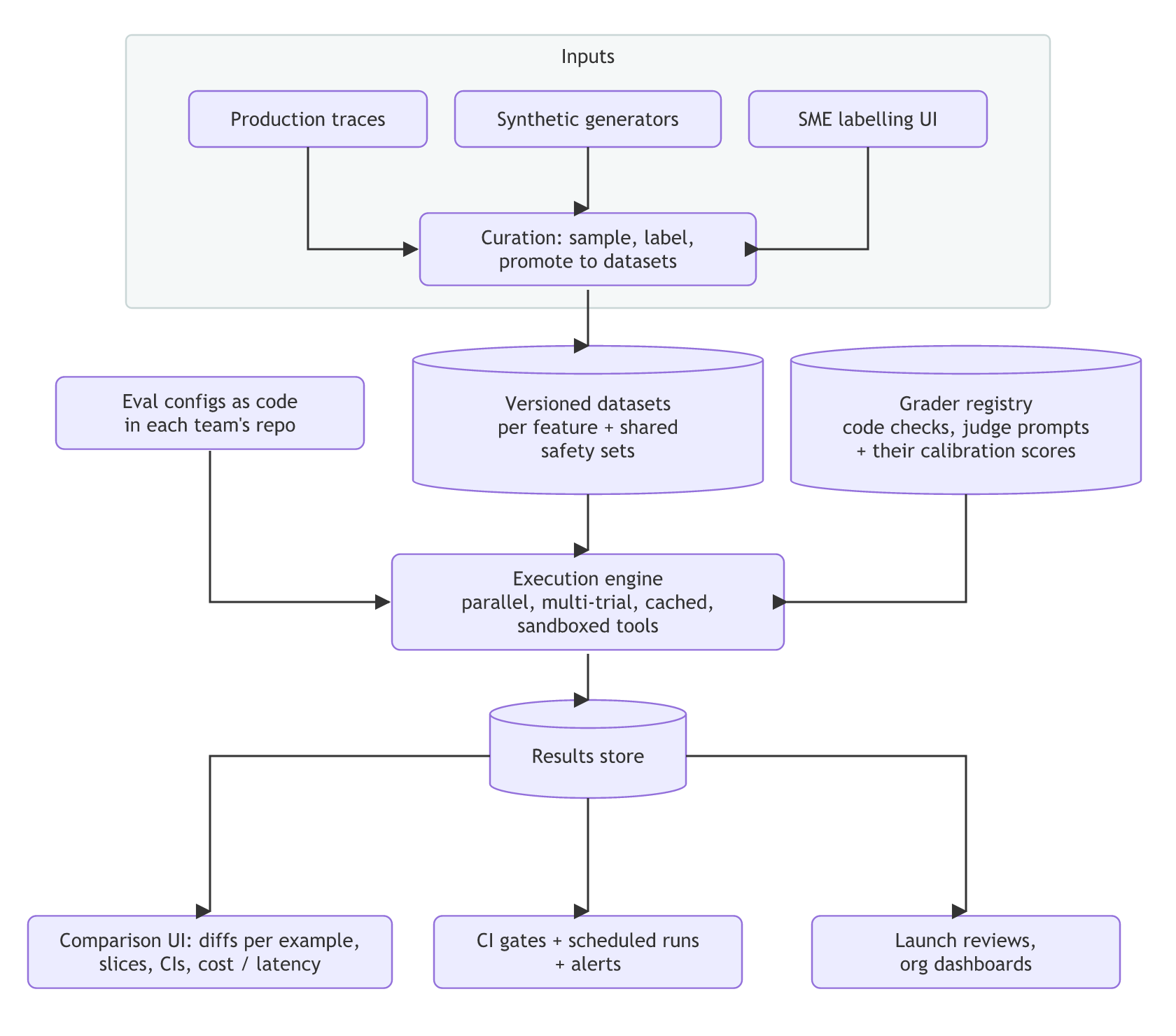
- Evals as code: each feature's eval config (dataset version, graders, thresholds) lives in its repo and is reviewed like code.
- Shared assets: org-wide safety and red-team sets, PII leak tests, and multilingual sets every feature must pass.
- Grader registry with calibration metadata: each judge records its agreement with humans (TPR/TNR) and the model version. Uncalibrated judges are flagged.
- Run efficiency: cache outputs per (input, system version); parallelise; run cheap subsets per PR and full suites nightly.
- Statistics built in: confidence intervals, paired comparisons, flipped-example views.
- Human review integration: low-agreement or high-stakes items go to labelling queues; labels flow back to the datasets.
- Governance: launch criteria templates (quality, safety, latency, cost), required for production releases.
- Access and privacy: datasets derived from production traces are PII-scrubbed, access-controlled and retained according to policy.
Success metrics: % of features with CI eval gates, regressions caught before release, time to set up evals for a new feature.
Related
Little by little, you're building something great.