
1
Curious builder0 XP earned · 300 to level 2
0 daysFinish a lesson to begin
Badge collection0 of 6 unlocked
51 small wins to finish your pathNext question →
What is an AI agent, and how is it different from a chatbot or a single LLM call?
30-second answerSay your answer out loud first, then reveal.
The simplest working definition is "an LLM that uses tools in a loop to reach a goal." Three things separate an agent from a normal LLM application:
- Autonomy over control flow. In a normal app, the developer hard-codes the steps: retrieve, then prompt, then answer. In an agent, the model decides what happens next: search again, call an API, ask the user, or stop.
- Tools / actions. The agent can do things beyond producing text: query a database, run code, send an email, call an API.
- Feedback from the environment. After each action, the agent sees the result (the "observation") and uses it to decide the next step. This closed loop lets it recover from mistakes.
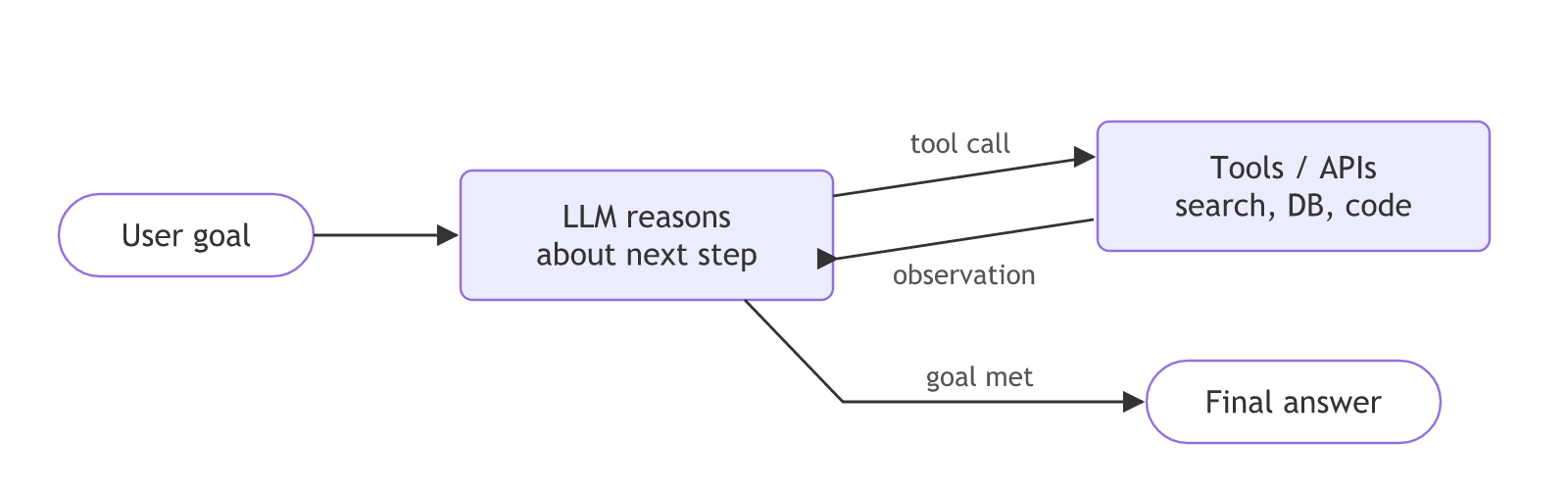
A useful spectrum: single LLM call → fixed chain (workflow) → router → tool-calling agent → multi-agent system. Each step gives the model more autonomy and adds more unpredictability, cost and latency. Strong candidates say outright that autonomy is a cost, and that you add only as much of it as the task needs.
Example. "Summarize this PDF" is a single LLM call. "Find our three biggest customers who churned last quarter, read their support tickets and draft a report on why" is agentic. The number of steps and queries isn't known in advance and depends on what the agent finds.
Common mistakes
- Calling anything with a prompt template an "agent."
- Saying agents are "smarter models." The model is the same; the difference is the loop and the tools.
Follow-ups to expect
- When would you not use an agent? (See Q4.)
- What stops the loop from running forever? (See Q12.)
Related
Little by little, you're building something great.