
1
Curious builder0 XP earned · 300 to level 2
0 daysFinish a lesson to begin
Badge collection0 of 6 unlocked
51 small wins to finish your pathNext question →
Explain common multi-agent architectures.
30-second answerSay your answer out loud first, then reveal.
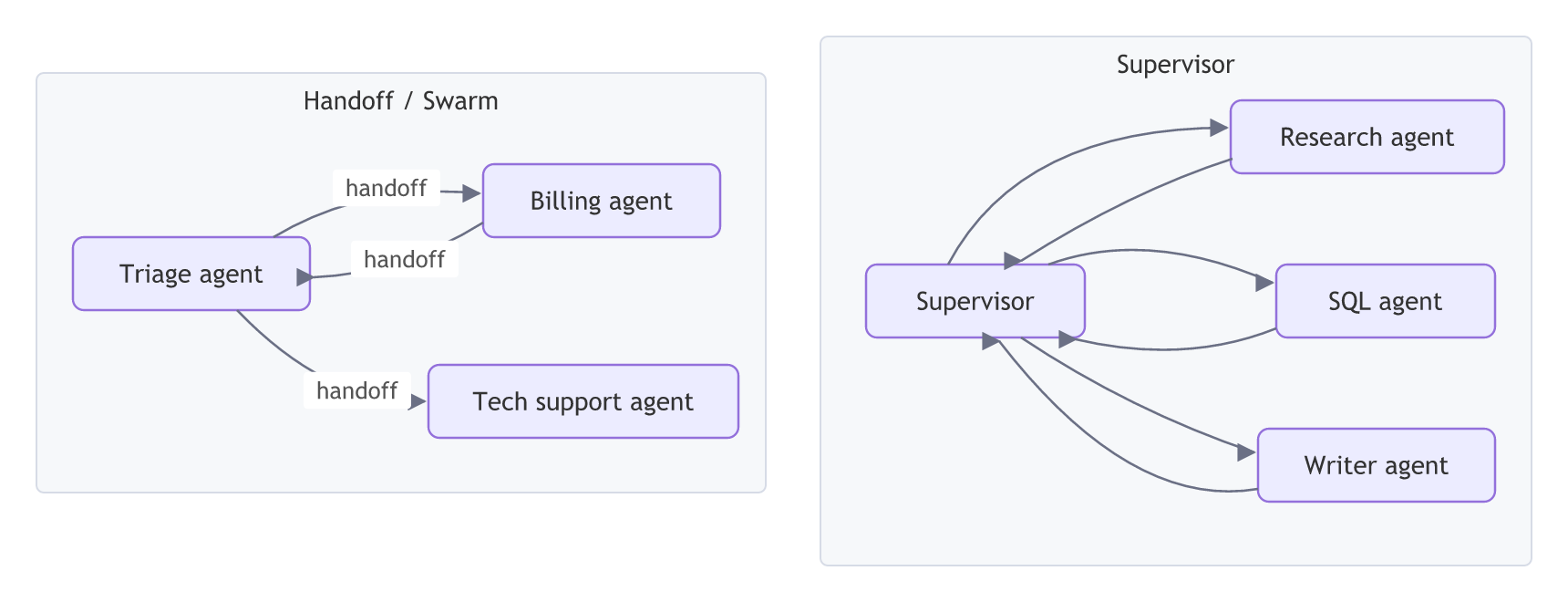
| Topology | Control | Pros | Cons | Example |
|---|---|---|---|---|
| Supervisor | Central | Easy to reason about, single place for policy | Supervisor is a bottleneck; extra hop each time | Research with specialised workers |
| Hierarchical | Tree | Scales to many agents | Deep latency, information loss across levels | Large enterprise workflows |
| Handoff / swarm | Decentralised, one active agent at a time | Natural for conversations, low overhead | Can ping-pong; harder global view | Customer support triage (OpenAI Agents SDK handoffs) |
| Network | Fully decentralised | Flexible | Hard to debug; can be chaotic | Simulations, debate |
| Sequential | Fixed | Predictable | Not adaptive | Draft → review → publish |
Design concerns for any topology
- Hand-off contracts: what state is passed (full history vs summary vs structured brief)? Losing context at handoff is a top failure mode.
- Shared state vs message passing.
- Termination: who decides the overall task is done?
- Observability: one trace spanning all agents.
Follow-ups to expect
- Supervisor vs "agents as tools"? They're similar. With agents as tools, the parent calls sub-agents like functions and keeps control, which is simpler.
Related
Little by little, you're building something great.