
1
Curious builder0 XP earned · 300 to level 2
0 daysFinish a lesson to begin
Badge collection0 of 6 unlocked
51 small wins to finish your path
A finance team asks you to build an "autonomous" agent that processes and approves vendor invoices. How do you scope, guard, and roll it out?
30-second answerSay your answer out loud first, then reveal.
Discovery
- Current process, volumes, error rates, approval matrix, compliance requirements (audit, segregation of duties), ERP systems.
- Define success: processing time, touchless rate, error rate, no increase in fraud or duplicate payments.
Architecture: workflow with agentic exceptions
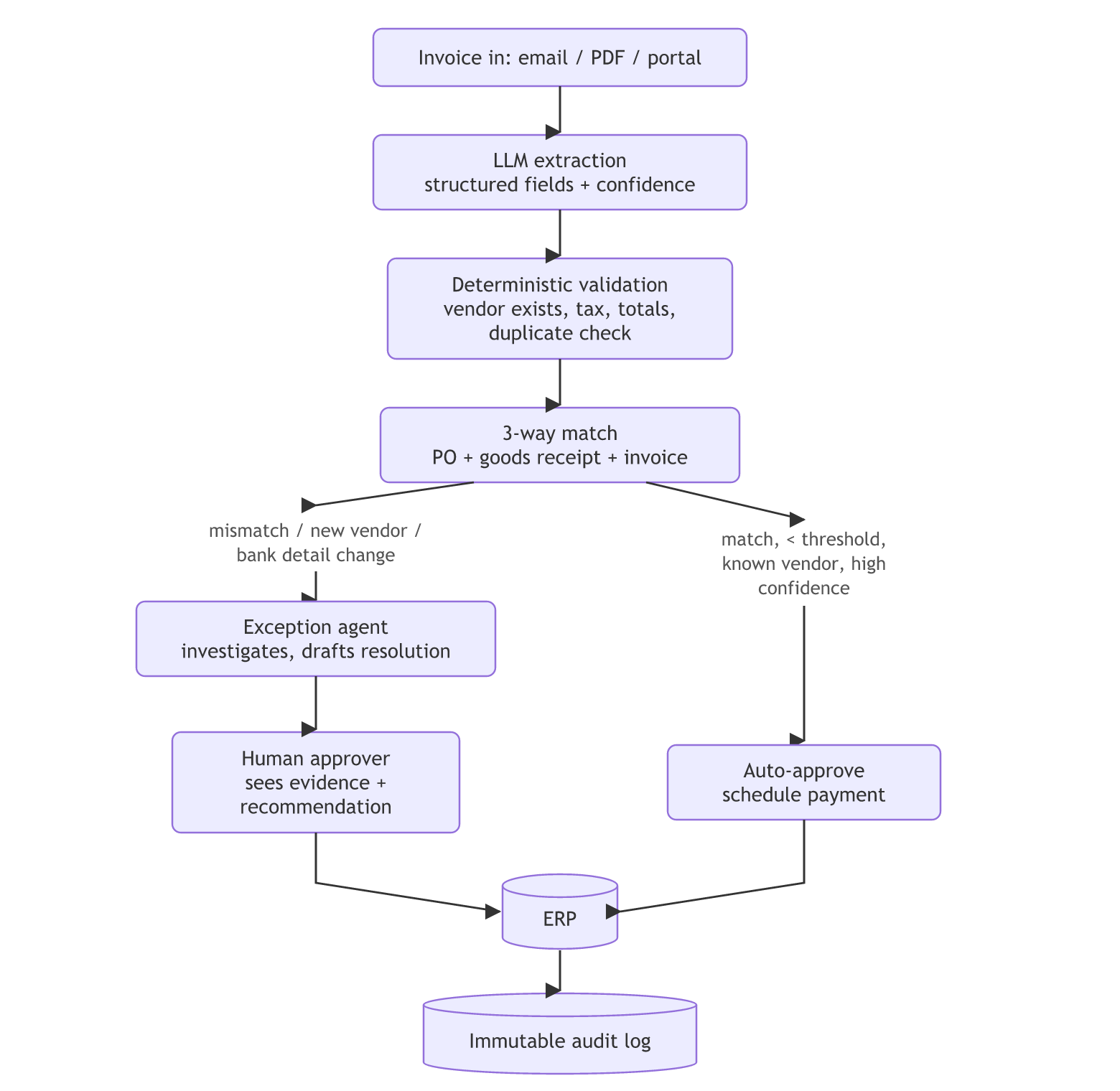
Controls (in code, non-negotiable)
- Amount thresholds per approval tier; segregation of duties (the agent can't both create a vendor and approve its invoices).
- Bank detail changes always require human verification. This is a classic fraud vector, and malicious invoices may contain prompt injections too.
- Duplicate detection (same vendor, amount, invoice number, fuzzy matches).
- The agent cannot execute payments directly; it schedules payments within ERP approval rules.
Staged rollout
- Shadow: the agent processes in parallel; compare with human decisions for 4–8 weeks.
- Assisted: the agent pre-fills and recommends; humans approve everything.
- Limited autonomy: auto-approve only matched, low-value invoices from trusted vendors.
- Expand thresholds as measured accuracy holds; monthly audit sampling.
Monitoring: extraction accuracy by field, auto-approval rate, exception reasons, override rate (human disagreed with the agent), anomaly alerts, cost per invoice.
What interviewers are testing: whether you push back on "fully autonomous" for high-stakes actions, put controls in deterministic code, and design for auditability and gradual trust. That is exactly the Forward Deployed Engineer mindset.
Related
Every expert started right here.