
1
Curious builder0 XP earned · 300 to level 2
0 daysFinish a lesson to begin
Badge collection0 of 6 unlocked
51 small wins to finish your pathNext question →
Design a customer-support agent for an e-commerce company with 1M monthly users.
30-second answerSay your answer out loud first, then reveal.
1. Clarify requirements
Always start here in a design round:
- Channels (web chat, WhatsApp, email)? Languages (English, Hindi, Hinglish)?
- Actions allowed: track order, cancel, return, refund, address change?
- SLAs: first response < 3s; resolution rate target, e.g. 60–70% without a human.
- Scale: 1M users/month ≈ maybe 300K conversations/month, with peaks during sales.
2. Architecture
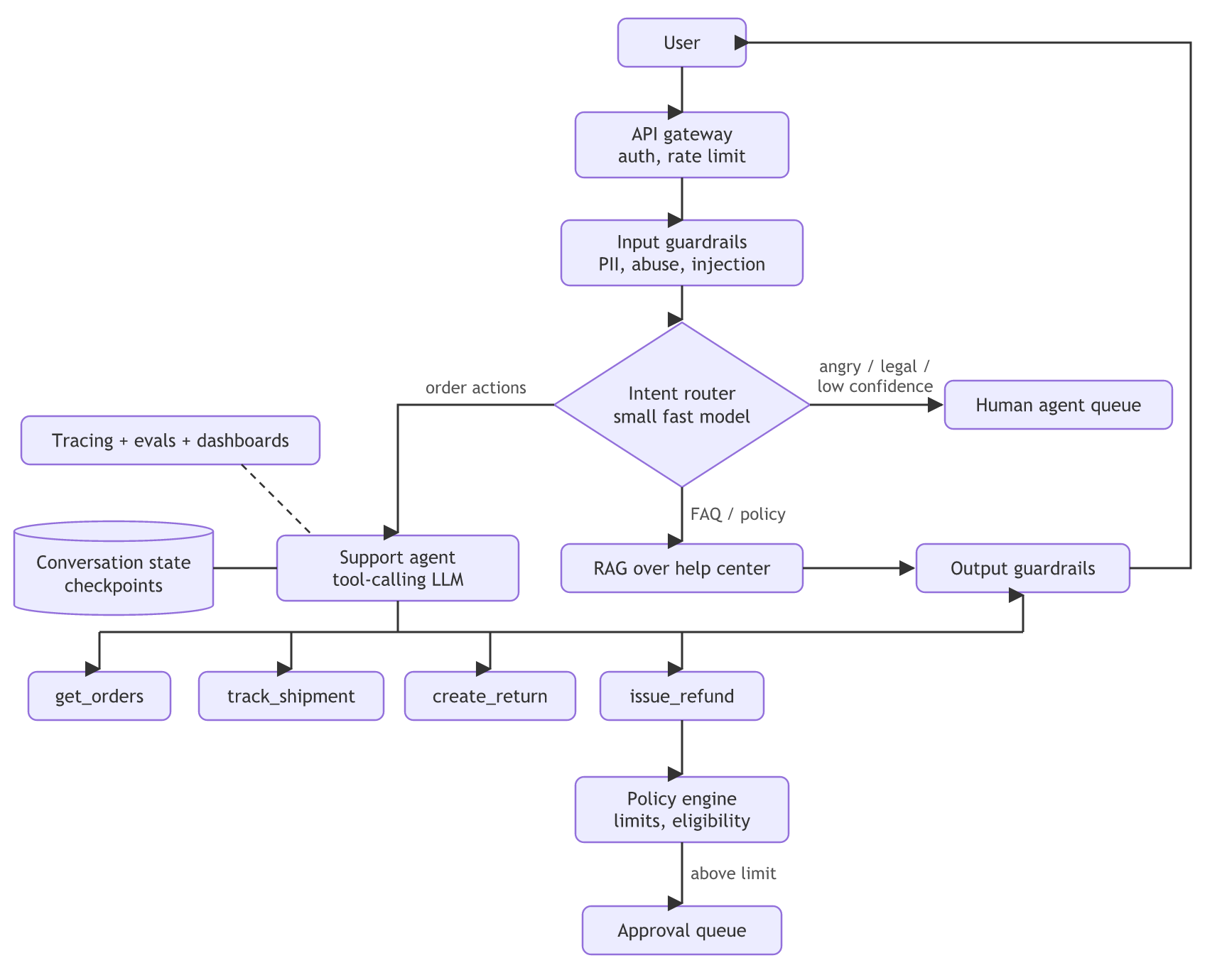
3. Key design decisions
- Router first: most traffic is simple ("where is my order?"). A cheap classifier keeps cost low and latency short.
- Tools scoped to the authenticated user: the tool layer injects
user_idfrom the session, never from model arguments. The agent cannot look up other users' orders even if tricked. - Policy in code: refund eligibility and limits live in the policy engine (Q26).
- Handoff to humans with a summary of the conversation, steps tried and customer sentiment, so the human doesn't restart.
- State: conversation thread with checkpoints; resumes across channels.
- Knowledge: RAG over help articles with freshness. Re-index on change, and cite articles.
4. Reliability and safety: timeouts and fallbacks for order APIs, circuit breakers, idempotent return/refund calls (Q32), injection defences for content pasted by users.
5. Evaluation and monitoring:
- Offline: 300+ scenario conversations (with a simulated user) covering policies and edge cases; pass^k.
- Online: resolution rate, escalation rate, CSAT, refund anomalies, cost per resolved conversation, p95 latency.
6. Cost: small model for routing and FAQs, larger model for complex agent cases; prompt caching of system prompt and tools; response cache for top FAQs.
7. Rollout: shadow mode (agent drafts, humans send) → 5% canary on low-risk intents → expand by intent.
Related
Little by little, you're building something great.