
1
Curious builder0 XP earned · 300 to level 2
0 daysFinish a lesson to begin
Badge collection0 of 6 unlocked
51 small wins to finish your path
Mock round: "Design an AI assistant for a bank's retail customers." Show how you'd run the 45 minutes.
30-second answerSay your answer out loud first, then reveal.
Minutes 0–5: Clarify
- Channels: mobile app chat, WhatsApp, voice? Languages: English, Hindi, regional?
- Scope v1: FAQs + account information (balance, transactions) + service requests (card block, statement)? Transfers in v1? (Suggest no, or only with strict confirmation flows.)
- Constraints: RBI/regulatory guidelines, data residency, audit, accessibility.
- Success: containment rate, CSAT, call-centre deflection, zero unauthorised actions.
Minutes 5–8: Estimates. 20M customers, 2M monthly active users of chat, ~10 sessions/user/month → ~670K sessions/day. Peak at salary days. Token and cost estimates; most traffic is simple intents, which argues for a router.
Minutes 8–18: High-level design
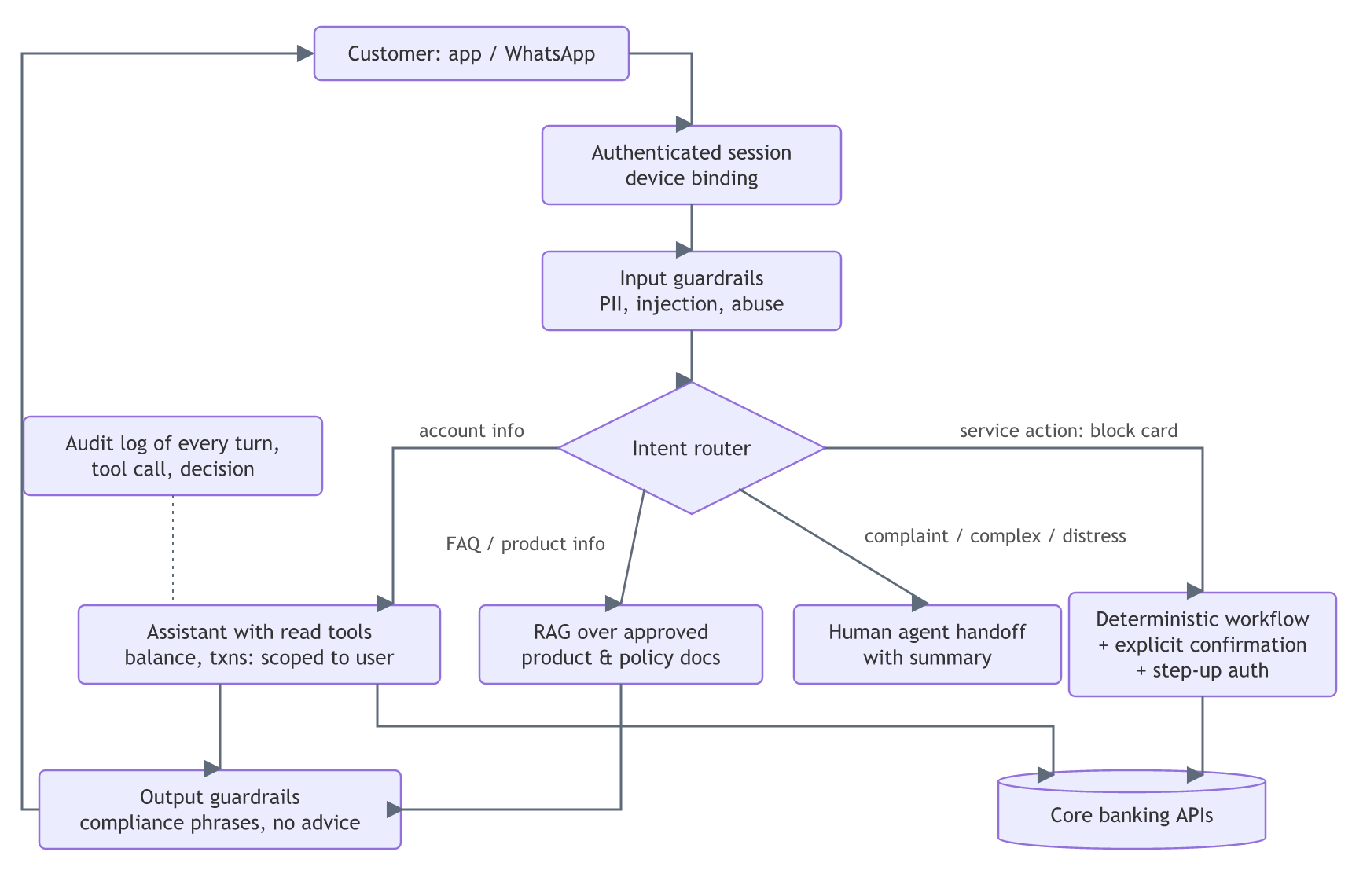
Minutes 18–33: Deep dives (examples)
- Authorisation: tools receive the customer ID from the session, never from the model; read-only scopes; transactions only via deterministic flows with OTP/biometric step-up.
- Hallucination control: answers about rates and fees come only from retrieved approved documents, with citations; if not found, say so and escalate; no financial advice beyond approved scripts.
- Prompt injection: transaction descriptions and uploaded documents are untrusted, and no tool can move money based on model output alone.
- Compliance: audit trails, retention, data residency in India, consent, complaint escalation rules.
Minutes 33–45: Evals, monitoring, rollout, trade-offs
- Golden sets per intent, red-team suites (social engineering, injection), multilingual evals.
- Shadow → internal staff → 1% customers → gradual expansion; kill switches per intent.
- Trade-offs discussed: coverage vs risk (start narrow), latency vs guardrail depth, API vs self-hosted given data constraints.
What this demonstrates. Structure, safety-first judgement in a regulated domain, and clear scoping. That's what interviewers grade most heavily.
Related
Every expert started right here.