
1
Curious builder0 XP earned · 300 to level 2
0 daysFinish a lesson to begin
Badge collection0 of 6 unlocked
51 small wins to finish your pathNext question →
Design a real-time voice AI agent (e.g. a phone-based customer support bot).
30-second answerSay your answer out loud first, then reveal.
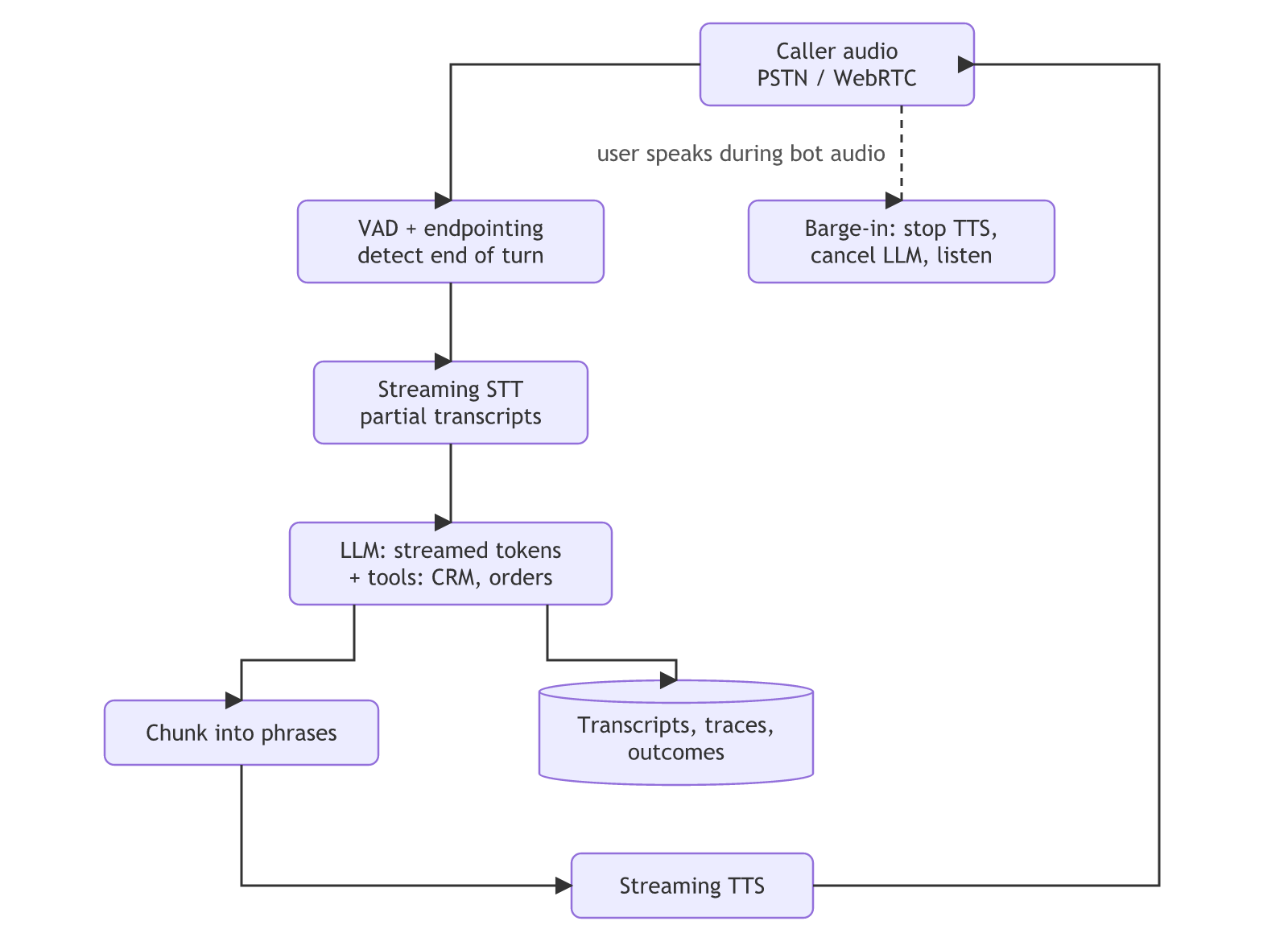
Latency budget (illustrative)
| Stage | Target |
|---|---|
| Endpointing (deciding the user finished) | 200–500ms |
| Final STT | ~100–300ms |
| LLM time to first token | 200–500ms |
| TTS time to first audio | 100–300ms |
| Network | 50–150ms |
Techniques: stream everything; start TTS on the first sentence; use fast models for routine turns; filler phrases while tools run ("Let me check your order..."); pre-fetch customer data at call start (caller ID lookup).
Voice-specific design
- Turn-taking: tune endpointing (too aggressive cuts users off, too slow feels laggy); semantic end-of-turn detection.
- Barge-in: stop playback immediately and discard unspoken text from context.
- Speech-friendly output: no markdown or lists; spell out numbers; confirm critical details ("That's order 4-5-7-2, correct?").
- Accents, noise, code-switching (Hindi/English): evaluate STT word error rate per segment.
- Escalation to a human with a transcript summary.
- Compliance: call recording consent, PII handling, payment card data must not pass through the LLM.
Metrics: containment rate, average handle time, latency percentiles, interruption rate, CSAT, escalation correctness.
Related
This is what real progress feels like.