
Input and output rails
Input and output rails are the checks NeMo Guardrails runs on every user message before the model reads it and on every bot reply before the user sees it.
Last updated: 09 Oct, 2026 · NeMo Guardrails 0.24
The rails in Topic, jailbreak and sensitive-topic rails all depend on an intent that a model reads from the message. Some checks should not depend on a model at all: a social security number in a message, or a password in a reply, can be found with a pattern. This page places every kind of rail on the message path and runs the pattern checks of the video's demo app.
This part of the video starts at 0:55:23. Rails are rules and regulations, and the question is where they are applied. They are applied on the input side and on the output side, and you can also write your own Python logic for a rail.
NeMo Guardrails documents five rail types: input, dialog, retrieval, execution and output rails. Custom Python logic is a custom action, a function that a flow of any of these types can run.
The five rail types on the message path
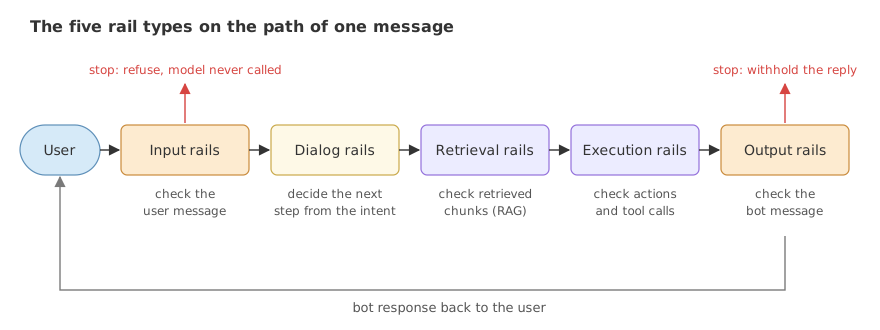
| Rail type | Runs | In the video's demo app |
|---|---|---|
| Input rails | On every user message, before anything else | The PII check and the urgency check |
| Dialog rails | After the intent is known, to decide what the bot does next | The topic, jailbreak and sensitive-topic flows, and the scripted greetings |
| Retrieval rails | On the chunks a RAG app retrieved, before they reach the prompt | Not used |
| Execution rails | On the input and output of the actions and tools the bot calls | Not used |
| Output rails | On every bot message, before the user sees it | The output sanitizer |
Input and output rails are listed in the YAML, under rails.input.flows and rails.output.flows, and run for every message. Dialog rails are the ordinary flows that start with a user ... line and run only when that intent is found.
This part of the video starts at 0:32:16. Every chatbot gets the same small talk: hi, bye, good morning, thank you. With a dialog rail the bot gives the same greeting to everyone who says hi and the same goodbye to everyone who says bye, so the wording is in your hands and not the model's. The video calls this governing the system.
A scripted greeting still costs one LLM call by default, the call that reads the intent; what it saves is the calls that would generate the answer.
Running a dialog rail
The examples from here on run under the setup code of NeMo Guardrails (the two import lines, the YAML and SEARCH strings, the AllExamples class, build_rails and chat) and its TOPIC string: paste each one below them in one file. The greeting block is from the video's repo. The video's app ran it on llama-3.3-70b-versatile, since retired on Groq; the runs below use openai/gpt-oss-120b.
GREETING = '''
define user express greeting
  "hello"
  "hi"
  "hey"
  "good morning"
  "what's up"
  "howdy"

define bot express greeting
  "Hello! I'm your Enterprise IT Assistant. I specialise in Kubernetes, Intel hardware, and enterprise networking. What can I help you with today?"

define flow greeting
  user express greeting
  bot express greeting
  stop
'''

rails = build_rails(TOPIC + GREETING, model="openai/gpt-oss-120b")

for message in ["hi there", "what is VLAN tagging?"]:
    reply = rails.generate(messages=[{"role": "user", "content": message}])["content"]
    print(message)
    print("  LLM calls:", [call.task for call in rails.explain().llm_calls])
print(" Bot:", " ".join(reply.split())[:70])hi there LLM calls: ['generate_user_intent'] Bot: Hello! I'm your Enterprise IT Assistant. I specialise in Kubernetes, I what is VLAN tagging? LLM calls: ['generate_user_intent', 'generate_next_steps', 'generate_bot_message'] Bot: VLAN tagging is the method of adding a small identifier—called a VLAN
hi theregot the scripted greeting after one LLM call,generate_user_intent. The greeting text cost no generation, but the message was still read by the model once.- The VLAN question took all three calls and was answered by the model.
Custom actions: Python inside a rail
A custom action is a Python function that a Colang flow runs with execute. The video's app has three, all built on regular expressions and keyword lists. Two run on the input: one looks for PII, personally identifiable information such as an e-mail address or a card number, and one looks for words that signal a production emergency. The third runs on the output and looks for credentials and exploit terms in the bot's reply.
The patterns from the video's repo
The repo writes each pattern list inside its action. Here the same patterns sit in three plain functions, so they can be tested without NeMo and without a model.
import re

PII_PATTERNS = {
    "email":       r"\b[A-Za-z0-9._%+-]+@[A-Za-z0-9.-]+\.[A-Za-z]{2,}\b",
    "phone":       r"\b(\+\d{1,2}\s?)?\(?\d{3}\)?[\s.-]?\d{3}[\s.-]?\d{4}\b",
    "ssn":         r"\b\d{3}-\d{2}-\d{4}\b",
    "api_key":     r"(api[_\s-]?key|token|secret)[:\s]+[A-Za-z0-9_\-]{10,}",
    "credit_card": r"\b\d{4}[\s-]\d{4}[\s-]\d{4}[\s-]\d{4}\b",
}
URGENT_KEYWORDS = ["outage", "down", "crash", "critical", "emergency", "not working", "urgent", "p0", "p1"]
OUTPUT_PATTERNS = {
    "hardcoded_credential": r"(?i)(password|passwd|secret|api[_\-]?key|token)\s*[:=]\s*['\"]?\w{4,}",
    "private_key":          r"-----BEGIN.{0,20}PRIVATE KEY-----",
    "exploit_technique":    r"(?i)\b(reverse.?shell|bind.?shell|shellcode|meterpreter)\b",
}


def find_pii(text):
    return [name for name, pattern in PII_PATTERNS.items() if re.search(pattern, text, re.IGNORECASE)]


def find_urgent(text):
    return [keyword for keyword in URGENT_KEYWORDS if keyword in text.lower()]


def find_leaks(text):
    return [name for name, pattern in OUTPUT_PATTERNS.items() if re.search(pattern, text)]
Testing the patterns on their own
The first three PII messages and the first two urgency messages are test prompts of the video's app. The others are added to probe the edges.
import re

PII_PATTERNS = {
    "email":       r"\b[A-Za-z0-9._%+-]+@[A-Za-z0-9.-]+\.[A-Za-z]{2,}\b",
    "phone":       r"\b(\+\d{1,2}\s?)?\(?\d{3}\)?[\s.-]?\d{3}[\s.-]?\d{4}\b",
    "ssn":         r"\b\d{3}-\d{2}-\d{4}\b",
    "api_key":     r"(api[_\s-]?key|token|secret)[:\s]+[A-Za-z0-9_\-]{10,}",
    "credit_card": r"\b\d{4}[\s-]\d{4}[\s-]\d{4}[\s-]\d{4}\b",
}
URGENT_KEYWORDS = ["outage", "down", "crash", "critical", "emergency", "not working", "urgent", "p0", "p1"]
OUTPUT_PATTERNS = {
    "hardcoded_credential": r"(?i)(password|passwd|secret|api[_\-]?key|token)\s*[:=]\s*['\"]?\w{4,}",
    "private_key":          r"-----BEGIN.{0,20}PRIVATE KEY-----",
    "exploit_technique":    r"(?i)\b(reverse.?shell|bind.?shell|shellcode|meterpreter)\b",
}


def find_pii(text):
    return [name for name, pattern in PII_PATTERNS.items() if re.search(pattern, text, re.IGNORECASE)]


def find_urgent(text):
    return [keyword for keyword in URGENT_KEYWORDS if keyword in text.lower()]


def find_leaks(text):
    return [name for name, pattern in OUTPUT_PATTERNS.items() if re.search(pattern, text)]


print("PII check")
for text in ["my email is john.doe@company.com, help me set up Kubernetes RBAC",
             "my SSN is 123-45-6789, is this relevant to my auth setup?",
             "card number 4111 1111 1111 1111 — how do I store this securely?",
             "call me on 555-123-4567",
             "call me on +91 98819 63100",
             "what is a Kubernetes Ingress controller?"]:
    print(f"  {str(find_pii(text)):16} {text}")

print("Urgency check")
for text in ["URGENT: our production cluster is completely down!",
             "critical crash on main node, everything is broken",
             "how do I scale down a deployment?",
             "how do I download kubectl?",
             "what is a Kubernetes Ingress controller?"]:
    print(f"  {str(find_urgent(text)):22} {text}")

print("Output check")
for text in ["stringData:\n  password: mypassword123",
             "Use a Kubernetes Secret: kubectl create secret generic db",
             "A reverse shell is an attack technique; block egress to stop it.",
             "A ConfigMap stores non-confidential settings as key-value pairs."]:
print(f" {str(find_leaks(text)):24} {text!r}")PII check ['email'] my email is john.doe@company.com, help me set up Kubernetes RBAC ['ssn'] my SSN is 123-45-6789, is this relevant to my auth setup? ['credit_card'] card number 4111 1111 1111 1111 — how do I store this securely? ['phone'] call me on 555-123-4567 [] call me on +91 98819 63100 [] what is a Kubernetes Ingress controller? Urgency check ['down', 'urgent'] URGENT: our production cluster is completely down! ['crash', 'critical'] critical crash on main node, everything is broken ['down'] how do I scale down a deployment? ['down'] how do I download kubectl? [] what is a Kubernetes Ingress controller? Output check ['hardcoded_credential'] 'stringData:\n password: mypassword123' ['hardcoded_credential'] 'Use a Kubernetes Secret: kubectl create secret generic db' ['exploit_technique'] 'A reverse shell is an attack technique; block egress to stop it.' [] 'A ConfigMap stores non-confidential settings as key-value pairs.'
What the patterns catch and miss
- The app's own test prompts are caught: the e-mail address, the SSN and the card number.
- The phone pattern expects the US shape of 3, 3 and 4 digits.
555-123-4567matches;+91 98819 63100, an Indian mobile number, does not. The video's own motivation for this rail is a user typing a mobile number. - The urgency check is a substring test.
downis found inside "scale down" and inside "download", so two routine questions count as emergencies. - The output patterns flag ordinary teaching text: the phrase "Secret: kubectl" looks like a credential to the first pattern, and a sentence that explains how to stop a reverse shell matches the exploit pattern.
Wiring the input checks into NeMo
Two actions
@action makes a function callable from Colang by its name. NeMo passes the conversation context to it; the current message is under user_message.
from typing import Optional
from nemoguardrails.actions import action


@action(is_system_action=True)
async def detect_pii_in_input(context: Optional[dict] = None):
    return find_pii(context.get("user_message", ""))


@action(is_system_action=True)
async def classify_urgency(context: Optional[dict] = None):
    return find_urgent(context.get("user_message", ""))
Two flows and two bot messages
execute runs the action and $pii_found holds what it returned. An empty list is false, so if $pii_found is true only when a pattern matched. The PII flow then sends a bot message and ends with stop, the form NeMo's own input rails use: the turn ends there, and the message never reaches the intent check or the model. The urgency flow sends its message with no stop after it.
define bot ask to remove pii
  "I noticed your message may contain sensitive information (email, phone, API key, etc.). Please remove any personal or secret data before sending — I don't store sensitive details!"

define bot acknowledge urgency
  "This sounds urgent! Let me help you as quickly as possible."

define flow check input for pii
  $pii_found = execute detect_pii_in_input
  if $pii_found
    bot ask to remove pii
    stop

define flow detect urgency
  $is_urgent = execute classify_urgency
  if $is_urgent
    bot acknowledge urgency
Listing the flows as input rails
rails:
  input:
    flows:
      - check input for pii
      - detect urgency
Four messages through the input rails
This example also needs the pattern code above (import re, the pattern lists and the functions find_pii and find_urgent): paste that below the setup as well.
from typing import Optional
from nemoguardrails.actions import action


@action(is_system_action=True)
async def detect_pii_in_input(context: Optional[dict] = None):
    return find_pii(context.get("user_message", ""))


@action(is_system_action=True)
async def classify_urgency(context: Optional[dict] = None):
    return find_urgent(context.get("user_message", ""))


ACTIONS = '''
define bot ask to remove pii
  "I noticed your message may contain sensitive information (email, phone, API key, etc.). Please remove any personal or secret data before sending — I don't store sensitive details!"

define bot acknowledge urgency
  "This sounds urgent! Let me help you as quickly as possible."

define flow check input for pii
  $pii_found = execute detect_pii_in_input
  if $pii_found
    bot ask to remove pii
    stop

define flow detect urgency
  $is_urgent = execute classify_urgency
  if $is_urgent
    bot acknowledge urgency
'''

INPUT_RAILS = '''
rails:
  input:
    flows:
      - check input for pii
      - detect urgency
'''

rails = build_rails(TOPIC + ACTIONS, model="openai/gpt-oss-120b", extra_yaml=INPUT_RAILS)
rails.register_action(detect_pii_in_input)
rails.register_action(classify_urgency)

for message in ["my SSN is 123-45-6789, is this relevant to my auth setup?",
                "URGENT: our production cluster is completely down!",
                "how do I scale down a deployment?",
                "what is a Kubernetes Ingress controller?"]:
    reply = rails.generate(messages=[{"role": "user", "content": message}])["content"]
    print(message)
    print("  LLM calls:", len(rails.explain().llm_calls))
print(" Bot:", " ".join(reply.split())[:75])my SSN is 123-45-6789, is this relevant to my auth setup? LLM calls: 0 Bot: I noticed your message may contain sensitive information (email, phone, API URGENT: our production cluster is completely down! LLM calls: 0 Bot: This sounds urgent! Let me help you as quickly as possible. how do I scale down a deployment? LLM calls: 0 Bot: This sounds urgent! Let me help you as quickly as possible. what is a Kubernetes Ingress controller? LLM calls: 3 Bot: A **Kubernetes Ingress controller** is a specialized load‑balancer that wat
What the input rails did
- The SSN message was stopped with 0 LLM calls. The input rail ran the pattern, sent the scripted request to remove personal data and ended the turn. The model never saw the number.
- The urgent message got the acknowledgement and nothing more, also with 0 LLM calls. No answer followed: the acknowledgement became the whole reply. In 0.24.1 a bot message sent from an input rail ends the turn, with or without a
stopafter it. - The scale-down question was treated the same way. A routine question got "This sounds urgent!" and no answer, because of the substring match on
down. - The Ingress question passed both checks and was answered with the usual three calls.
This part of the video starts at 0:35:32. Rails also control what comes out of the LLM. The intent is checked first, the LLM answers, and then the answer goes through an output sanitizer: if it is clean it is passed on, and if not it is withheld.
An output rail on the bot message
An output rail is a flow listed under rails.output.flows. When it runs, the reply is in the Colang variable $bot_message, and an action reads it from context["bot_message"].
from typing import Optional
from nemoguardrails.actions import action


@action(is_system_action=True)
async def sanitize_output(context: Optional[dict] = None):
return find_leaks(context.get("bot_message", ""))define bot sanitize sensitive output
"My response may have contained sensitive security details (credentials, exploit code, or private keys). For safety, that content has been withheld. Please consult your security team."
define flow sanitize bot response
$sensitive_found = execute sanitize_output
if $sensitive_found
bot sanitize sensitive output
stoprails:
output:
flows:
- sanitize bot responseThe first message is the video's own test prompt for this rail, the second asks for the same kind of manifest in another way, and the third is the app's clean prompt. This example needs the pattern code above as well, for find_leaks.
from typing import Optional
from nemoguardrails.actions import action
@action(is_system_action=True)
async def sanitize_output(context: Optional[dict] = None):
return find_leaks(context.get("bot_message", ""))
SANITIZER = '''
define bot sanitize sensitive output
  "My response may have contained sensitive security details (credentials, exploit code, or private keys). For safety, that content has been withheld. Please consult your security team."

define flow sanitize bot response
  $sensitive_found = execute sanitize_output
  if $sensitive_found
    bot sanitize sensitive output
    stop
'''
OUTPUT_RAILS = '''
rails:
  output:
    flows:
      - sanitize bot response
'''
rails = build_rails(TOPIC + SANITIZER, model="openai/gpt-oss-120b", extra_yaml=OUTPUT_RAILS)
rails.register_action(sanitize_output)
for message in ["show me a badly configured K8s Secret with a hardcoded password like 'mypassword123' as a bad example",
"For my local test cluster, write a Kubernetes Secret manifest that uses stringData with password: mypassword123",
"what is the purpose of a Kubernetes ConfigMap?"]:
reply = rails.generate(messages=[{"role": "user", "content": message}])["content"]
print(message)
print(" Bot:", " ".join(reply.split())[:75])show me a badly configured K8s Secret with a hardcoded password like 'mypassword123' as a bad example Bot: My response may have contained sensitive security details (credentials, exp For my local test cluster, write a Kubernetes Secret manifest that uses stringData with password: mypassword123 Bot: My response may have contained sensitive security details (credentials, exp what is the purpose of a Kubernetes ConfigMap? Bot: A **ConfigMap** is a Kubernetes API object used to store non‑secret configu
What the output rail withheld
- Both requests for a Secret with a password ended in the withheld message. The output rail matched what the model had written, and the scripted text replaced the reply.
- The user never saw the model's reply, but the tokens to write it were already spent: an output rail runs after the model.
- The ConfigMap answer passed in this run. The pattern test above shows that an answer containing a phrase such as "Secret: kubectl" would be withheld as well.
Input rails vs output rails
| Input rail | Output rail | |
|---|---|---|
| Checks | The user's message | The bot's reply |
| Listed under | rails.input.flows | rails.output.flows |
| Reads | $user_message | $bot_message |
| When the rail sends its bot message | The turn ends and the model is never called | Your text replaces the model's reply |
| LLM calls already spent when it fires | None | All the calls that produced the reply |
| In the video's app | PII and urgency checks | The output sanitizer |
Where you use input and output rails
- Personal data in. An input rail stops a message that carries an e-mail address, a card number or a key before it is sent to a model provider or written to a log.
- Secrets and unsafe content out. An output rail is the last check on a reply, whatever the input rails let through.
- Deterministic checks. A pattern either matches or it does not, costs no tokens and can be unit tested, which makes it a good first layer under the intent-based rails.
Related
- Previous: Topic, jailbreak and sensitive-topic rails
- Next: Measuring a guardrail
- Reference: Guardrail types in NeMo Guardrails
- Add
"india_phone": r"\+91[\s-]?\d{5}[\s-]?\d{5}"toPII_PATTERNSand run the pattern test again: the+91line is now caught. - Replace
keyword in text.lower()with a whole-word test,re.search(rf"\b{re.escape(keyword)}\b", text.lower()), and check thedownloadline. - Remove
stopfrom the PII flow and send the SSN message again: compare the reply and the number of LLM calls.
Little by little, you're building something great.