
Generative AI vs AI agents vs agentic AI
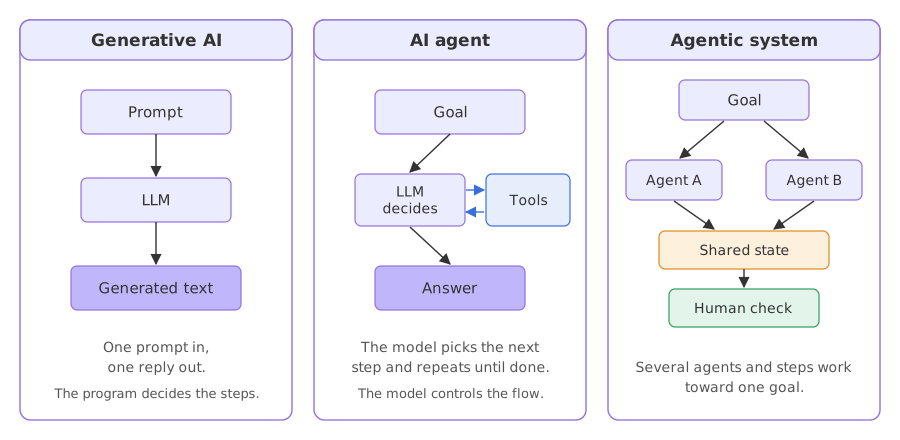
Generative AI creates content from a prompt, an AI agent is a system in which a language model chooses its own next step and uses tools in a loop to reach a goal, and agentic AI is the wider name for systems built from such agents.
Last updated: 08 Oct, 2026
The three terms are often used as if they meant the same thing. They describe three levels of how much a model is allowed to decide, and the difference decides how you build and test each one.
What a plain language model cannot do
Generative AI, from What is generative AI, is one prompt in and one reply out. The video starts from what that cannot do. A language model is trained on past data, so it cannot know today's news or who won a match played this morning. It was not trained on a company's private data either, so it cannot answer questions about it. To answer, it needs an outside source: a search tool, a database or your documents.
AI agents: a model that chooses tools in a loop
An AI agent is a language model that is given tools and a goal and decides for itself what to do next. The model does not run a tool. It replies with a request that names a tool and its arguments, the program runs the function and adds the result to the messages, and the model reads everything again and decides the next step. When it asks for no more tools, its reply is the answer.
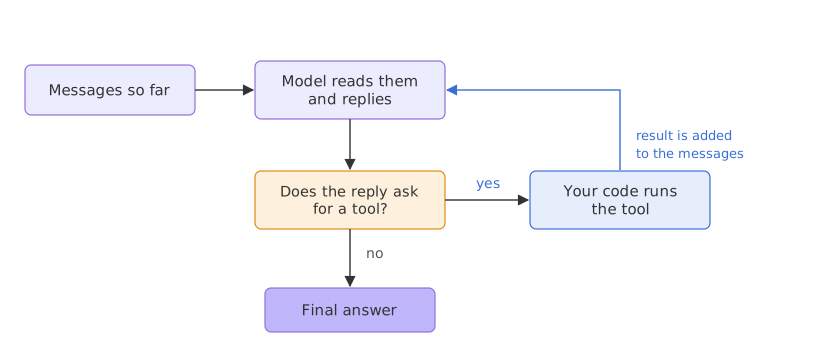
The video's example is the smallest agent: a model that cannot answer a question about today's news gets a search tool, asks for a search, reads the result and writes the answer. With a loop, the same model can search, read the result, decide the first search was too narrow and search again. AI agents builds one, and Tool calling shows the tool request and the result message.
Agentic AI: systems built from agents
The video's example is a system that turns a YouTube video into a blog post. The job splits into four tasks: take the transcript, write a title, write a description and write a conclusion. Each task is given to an agent, the transcript goes to all of them, their outputs are combined into the final post, and a human can give feedback. In the video's words, one agent does one task, and in an agentic AI system the agents collaborate on a goal.
That is one common use of the term: a single task-specific agent against a system of several agents that coordinate. A 2025 review, AI Agents vs. Agentic AI: A Conceptual Taxonomy, Applications and Challenges, draws the line the same way. The other common use comes from Anthropic's guide Building effective agents, which calls every system of this kind agentic and divides it by who controls the flow. In a workflow, models and tools follow code paths that you wrote in advance. In an agent, the model directs its own process and its use of tools.
By that second test, the blog pipeline is a workflow: the order of the four tasks is fixed by the program. It would become agent-like if a model decided which tasks to run, in what order, and when the post was good enough.
Generative AI vs agent vs agentic system
| Generative AI call | Workflow | AI agent | Several agents | |
|---|---|---|---|---|
| Who picks the next step | Nobody: one call | Your code | The model | The model, or a supervisor |
| Tools | None | Called by your code | Chosen by the model | Each agent has its own |
| Repeats | No | As written in the code | Until the model stops asking for tools | Until the goal is met |
| Easy to test | Yes | Yes | Harder: the path changes | Hardest: paths multiply |
| Built in | Your first LLM app | Retrieval-augmented generation (RAG) | AI agents | Multi-agent systems |
Choosing between a call, a workflow and an agent
Anthropic's guide recommends the simplest solution that works and more structure only when it is needed. A single call with good context often is enough. Use a workflow when the steps are known in advance, and an agent when the steps depend on what the model finds along the way. Agents can solve harder problems, and they cost more, take longer and fail in more ways, so Loop engineering and Harness engineering are about keeping them under control.
Where you use each one
- A generative call: summarise this email, rewrite this paragraph, classify this ticket.
- A workflow: answer a question from your documents with the same steps every time: retrieve, build a prompt, answer.
- An agent: research a topic, where the next search depends on what the last one returned.
- A system of agents: a writer agent and a reviewer agent that pass a draft back and forth until it passes a check.
Related
- Previous: What is generative AI
- Next: How LLMs are built
- See also: AI agents and Multi-agent systems
- Take a task from your own work and write which of the four columns in the table fits it, and why.
- Rewrite the YouTube-to-blog example so that a model decides which of the four tasks to run. What new thing must the program now handle?
- List one thing that could go wrong in a loop with no maximum number of steps.
Slow is fine. Stopping is the only problem.