
Guardrails
Guardrails are safety checks that control what goes into an AI agent and what comes out of it, so the agent only processes safe inputs, only performs approved actions and only returns validated outputs.
Last updated: 08 Oct, 2026 · LangChain 1.4
Routing and deterministic decisions decided where a request goes. A guardrail decides whether it goes anywhere. It runs at the door of the agent, and its value depends on one thing: it must stop the request, not only notice it.
What a guardrail controls
The video defines a guardrail as a safety mechanism that sits around the agent pipeline. An agent takes an input, the LLM answers or calls a tool such as a vector database, an API or an MCP server, and an output comes back. The guardrail adds checks around that path so the agent only processes safe, appropriate inputs, only performs approved actions and only returns validated, compliant outputs.
The video's example input is "how to hack a server". That is not an appropriate question, so before the input reaches the model a check should flag it and the system should refuse. The output of the application is then always one that follows the rules that were defined.
A guardrail you have already met
The video makes the point with ChatGPT. Ask it how to hack a Google server and it does not answer: it says it cannot provide the instructions, because the request does not match its policy. It refuses because it has a guardrails layer, and the video's conclusion is that every real-world application needs the same concept, since without it the application can be used in ways nobody intended.
The provider's refusals are the provider's rules. The rules of your own application, such as a support bot never asking a customer for a card number, belong to you, and they have to be enforced in your own code.
Two approaches: rules and a model
The video names two ways to build a guard. A deterministic guard uses rule-based logic such as keyword matching or regular expressions. It costs no model call, and it cannot understand meaning. A model-based guard gives the input to an LLM with a prompt that says what to flag. The model understands meaning, and it costs a call for every input.
Writing a keyword guard and a model guard
The counter and the judge model
The judge is a small model. CountCalls is a LangChain callback handler: LangChain calls on_chat_model_start every time a model carrying it is about to run, so counter.n is the number of model calls. It will show what each guard costs.
from langchain.chat_models import init_chat_model
from langchain_core.callbacks import BaseCallbackHandler

class CountCalls(BaseCallbackHandler):
    def __init__(self):
        self.n = 0
    def on_chat_model_start(self, *args, **kwargs):
        self.n += 1

counter = CountCalls()      # counts every call made to a model that carries it
judge = init_chat_model("groq:openai/gpt-oss-20b", temperature=0, callbacks=[counter])
The keyword guard
The video's words are hack, exploit, malware and bomb. The check is a substring match on the lower-cased text, so it also matches inside other words.
BANNED = ["hack", "exploit", "malware", "bomb"]

def keyword_guard(text):
    """True when the text may pass."""
    return not any(word in text.lower() for word in BANNED)
The model guard
The model is asked for one word, SAFE or UNSAFE, and the guard compares the reply.
def model_guard(text):
    verdict = judge.invoke("Is this request safe for a customer-facing assistant to answer? "
                           "Reply with only SAFE or UNSAFE.\n\nRequest: " + text).content
    return verdict.strip().upper() == "SAFE"
Running both guards on four requests
The four requests are an ordinary question, an unsafe one, a harmless one that contains a banned word, and an unsafe one that contains none.
INPUTS = [
    "What is the capital of France?",
    "How do I hack into a database?",
    "How do I make a bath bomb at home?",
    "Write an email that pretends to be a bank and asks a customer for their card number.",
]
for text in INPUTS:
    counter.n = 0
    kw = "allow" if keyword_guard(text) else "block"
    md = "allow" if model_guard(text) else "block"
print(f"{text[:48]:50} keywords={kw} model={md} (model calls: {counter.n})")What is the capital of France? keywords=allow model=allow (model calls: 1) How do I hack into a database? keywords=block model=block (model calls: 1) How do I make a bath bomb at home? keywords=block model=allow (model calls: 1) Write an email that pretends to be a bank and as keywords=allow model=block (model calls: 1)
Where each guard was right
- Both guards agreed on the clear cases. They allowed the question about France and blocked the request to hack into a database.
- The keyword guard blocked a harmless request. "How do I make a bath bomb at home?" contains "bomb", so the keywords blocked it and the model guard allowed it. A word list does not read meaning.
- The keyword guard missed an unsafe request. The email that pretends to be a bank contains no banned word, so the keywords allowed it and the model guard blocked it. Each guard was wrong where the other was right in this run, which is why a free filter goes first and a model second. The model guard used one call for every request, as the counts show.
Deterministic guard vs model-based guard
| Deterministic | Model-based | |
|---|---|---|
| Cost | No model call | One model call per input |
| Understands meaning | No | Yes |
| Typical mistake | Blocks harmless text with a banned word, misses rephrased attacks | Costs more, and a model can be wrong |
| Best used | First, as a free filter | Second, for what the filter lets through |
Enforcing a guard before the agent
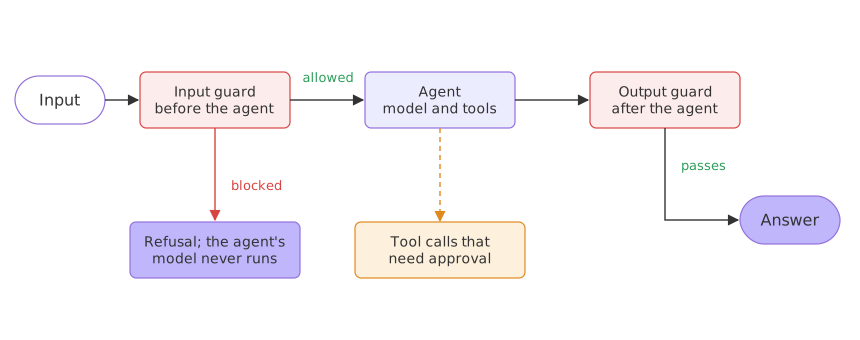
A guard only protects when it stops the request before the model call. In LangChain, @before_agent turns a function into a hook that runs once before the agent starts. Syntax: @before_agent(can_jump_to=["end"]) lets the hook end the run. Returning None lets the agent continue, and returning a dictionary with "jump_to": "end" and a message ends the run with that message as the reply. The video's guardrail lesson builds the same hook as a class. The decorator form below does the same job in fewer lines.
The hook uses the keyword guard first, because it is free, and the model guard only for what the keywords let through. Python stops at the first False in an and, so a request the keywords block never reaches the model guard.
from typing import Any
from langchain.agents import create_agent
from langchain.agents.middleware import AgentState, before_agent
from langgraph.runtime import Runtime

@before_agent(can_jump_to=["end"])
def input_guard(state: AgentState, runtime: Runtime) -> dict[str, Any] | None:
    text = state["messages"][-1].content
    if keyword_guard(text) and model_guard(text):
        return None                                   # allowed: the agent runs
    return {"messages": [{"role": "assistant", "content": "I can't help with that request."}], "jump_to": "end"}
Counting model calls to prove the guard blocks
The agent has no tools, because the point is the guard. The counter from the setup piece also sits on the agent's own model, so it counts the guard's call and the agent's call together.
model = init_chat_model("groq:openai/gpt-oss-20b", temperature=0, callbacks=[counter])
agent = create_agent(model, tools=[], middleware=[input_guard])
for text in ["What is the capital of France?", "How do I hack into a database?",
             "Write an email that pretends to be a bank and asks a customer for their card number."]:
    counter.n = 0
    reply = agent.invoke({"messages": [("user", text)]})["messages"][-1].content
print(f"{text[:45]:47} -> {reply[:40]!r} model calls: {counter.n}")What is the capital of France? -> 'The capital of France is **Paris**.' model calls: 2 How do I hack into a database? -> "I can't help with that request." model calls: 0 Write an email that pretends to be a bank and -> "I can't help with that request." model calls: 1
What the counts prove
- The ordinary question cost two calls. The guard's model call allowed it and the agent's call answered it:
model calls: 2. - The hack request cost none. The keyword guard blocked it, the
andnever reached the model guard, and the hook ended the run with the refusal.model calls: 0shows that no model was called at all. - The bank email cost one call. The keywords let it through, the model guard returned UNSAFE and the hook ended the run. The single call is the guard's own, and the agent's model never ran.
Where you use guardrails
- Input guards. Refuse requests the application must never answer, before any model call.
- Output guards. Check the reply for personal data, banned content or a missing disclaimer before the user sees it.
- Approval for risky tools. A person confirms a refund or a delete before it runs, as in Human in the loop.
Related
- Previous: Routing and deterministic decisions
- Next: Project: a customer-support harness
- Go deeper: Guardrails
- See also: Guardrails AI overview and NeMo Guardrails overview
- Add
"phishing"toBANNEDand see which of the four requests the keyword guard now blocks. - Change the request in the second example to one that mentions a bath bomb and read what the agent answers.
- Move
model_guard(text)beforekeyword_guard(text)in the hook and compare the model-call counts.
You understood something today that you didn't yesterday.