AI vs ML vs DL vs data science
Artificial intelligence (AI) is the field of applications that do their task without human intervention; machine learning (ML) is the part of AI that learns from data with statistical tools, and deep learning (DL) is the part of ML that uses multi-layered neural networks.
Last updated: 05 Oct, 2026 · NumPy
The four names are used loosely in job titles, and "AI vs ML vs DL vs DS" is a standard first interview question. The video answers it with one drawing, sets inside sets, and one rule: whatever the role, the end product is an AI application.
Defining an AI application
Picture a whole universe and call it AI, artificial intelligence. An AI application can do its own task without any human intervention: nobody tells it what to do, and it takes its own decisions from the behaviour of the person using it. The video's examples:
- Netflix recommends movies automatically from what you watch.
- Self-driving cars, the autopilot cars, drive themselves.
- Amazon recommends products while you shop.
- Sophia, the robot, and chatbots hold a conversation.
Most AI applications are an AI module added to software that already exists. Netflix is for watching movies; the recommendation model on top makes the experience better. Whether you work as a computer vision developer, a data scientist or a deep learning developer, what you build in the end is an AI application.
The aside in the clip names YouTube by mistake: the company Elon Musk agreed to buy was Twitter, for about 44 billion US dollars, and one reason he gave was to open-source its recommendation algorithm.
Placing machine learning inside AI
Machine learning is a subset of AI. It provides stats tools to analyse the data, visualise the data, make predictions and forecasts, and, in unsupervised learning, cluster it. Power BI is the video's example of where this shows up: it uses machine learning algorithms and visualisation inside, yet the product itself is an AI application. Other fields, such as natural language processing, are part of the same picture.
Placing deep learning and data science
Deep learning is a subset of machine learning. It is built on multi-layered neural networks, its first network was the perceptron, research on it goes back to 1958, and its main aim is to mimic the human brain. The clip for this part of the board sits in Deep Learning.
Data science can be part of everything. On the board it is a red circle that overlaps ML and DL and reaches past the edge of AI; the board leaves it unlabelled, and the diagram here names it DS. A data scientist may work as a data analyst, build ML models or train DL networks, and the goal stays the same: an AI application. Computer vision likewise can be done with ML or DL.
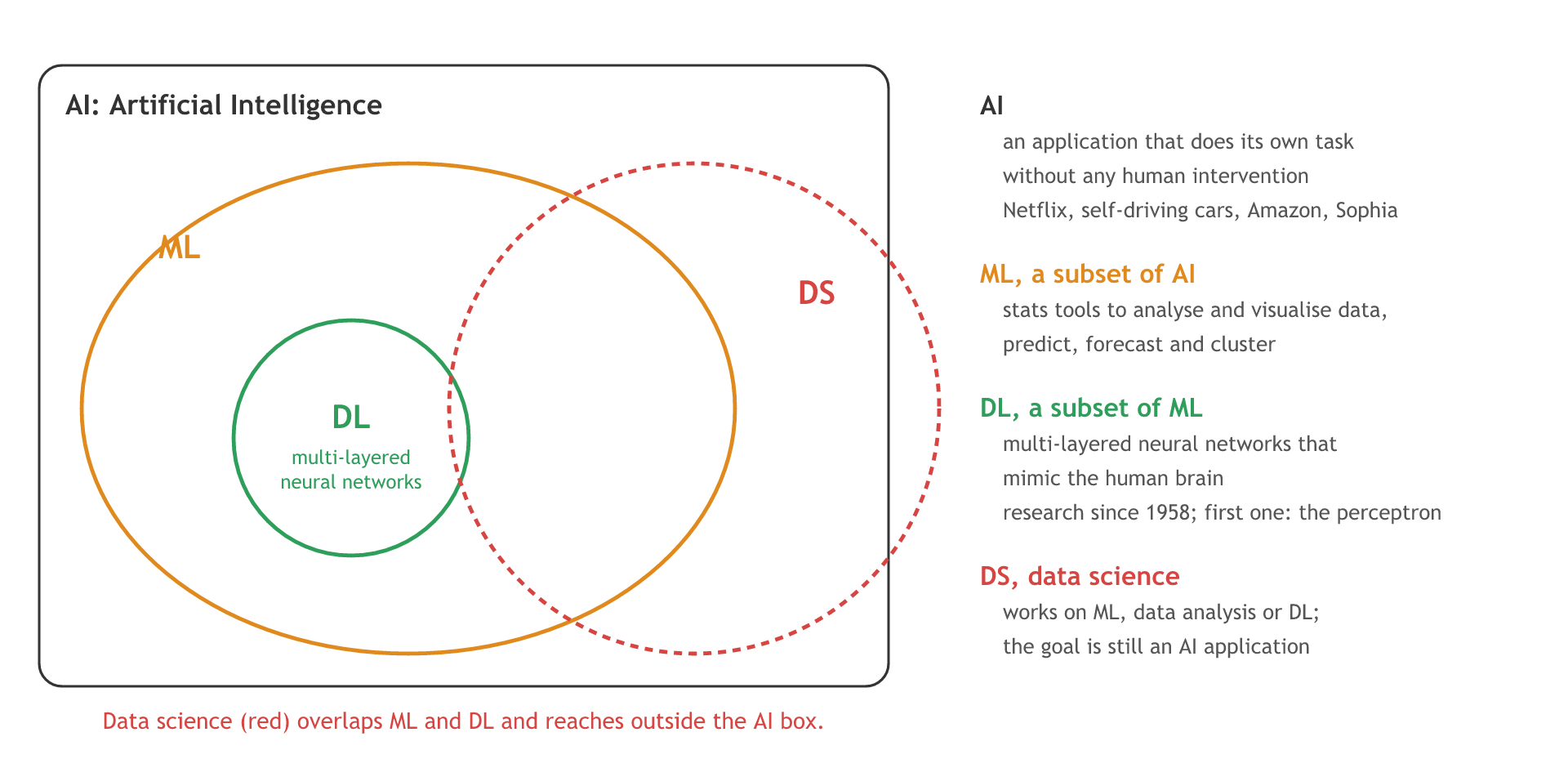
Listing the families of deep learning
The notes for this topic add a map of what sits inside the DL circle. Each family is a different way of wiring neurons for a different kind of input:
| Family | Input | Used for | In this course |
|---|---|---|---|
| ANN, artificial neural network | Rows of numbers (a table) | Classification and regression | The perceptron to the churn ANN in Keras |
| CNN, convolutional neural network | Images and video frames | Image classification; object detection with R-CNN, Mask R-CNN, Detectron and YOLO | The CNN part, with a Keras practical |
| RNN, recurrent neural network | Text and time series | NLP: word embeddings, LSTM, GRU, bidirectional LSTM, encoder-decoder, transformers, BERT | Named only; a course of its own |
Seeing one neuron inside machine learning
The nesting can be checked in code. A logistic regression, a classical ML model, is one neuron: it takes a weighted sum of the inputs plus a bias and passes it through a sigmoid. Fit it on the video's student table and compute the same answer by hand with NumPy. To run this, install the libraries first (Installing TensorFlow).
The student table
import numpy as np
from sklearn.linear_model import LogisticRegression

# the video's student table: study, play and sleep hours, pass (1) or fail (0)
X = np.array([[7, 3, 7], [2, 5, 8], [4, 3, 7]])
y = np.array([1, 0, 1])
A logistic regression's weights and bias
model = LogisticRegression(random_state=0).fit(X, y)   # a classical ML model
w, b = model.coef_[0], model.intercept_[0]             # its learned weights and bias
Comparing the model with a hand-made neuron
z = X[0] @ w + b                     # weighted sum + bias for the row 7, 3, 7
neuron = 1 / (1 + np.exp(-z))         # sigmoid activation
print("weights:", np.round(w, 3), "bias:", round(float(b), 3))
print("neuron by hand:     ", round(float(neuron), 4))
print("logistic regression:", round(float(model.predict_proba(X[:1])[0, 1]), 4))weights: [ 0.613 -0.493 -0.247] bias: 2.1 neuron by hand: 0.9602 logistic regression: 0.9602
Reading the one-neuron check
- The two numbers match. The model's probability of a pass for the row 7, 3, 7 is the sigmoid of its weighted sum: a logistic regression is a one-neuron network.
- Study hours get a positive weight, play and sleep hours negative ones: the model learned that more study pushes towards a pass and more play towards a fail, the pattern in the three rows.
- Deep learning stacks many such neurons in layers and trains them together, which is why it sits inside machine learning and not beside it.
AI vs ML vs DL vs data science
| Term | What it is | How it works | Example from the video |
|---|---|---|---|
| AI | Applications that do their task without human intervention | Any method: rules, ML or DL | Netflix, self-driving cars, Amazon, Sophia, chatbots |
| ML | A subset of AI | Stats tools to analyse, visualise, predict, forecast and cluster | Power BI's built-in algorithms |
| DL | A subset of ML | Multi-layered neural networks that mimic the brain | The perceptron, then ANN, CNN and RNN |
| Data science | A role that overlaps all three | Analysis, ML or DL as the problem needs | Data analyst, ML or DL work, all ending in an AI application |
Where you use AI, ML and DL
- Interviews. The nested drawing answers the first question in one sketch, and "where does computer vision fit?" has the answer "in ML or in DL".
- Choosing an approach. A table of a few thousand rows suits classical ML; images, audio and long text usually need DL.
- Reading job titles. Data scientist, ML engineer and DL developer all ship AI applications; the title says which tools come first.
Related
- Previous: Deep Learning
- Next: Why deep learning is popular
- See also: Logistic regression in the Machine Learning course
- Change
X[0]toX[1]andX[:1]toX[1:2], the row 2, 5, 8 (a fail), and check that the two probabilities still match, now below 0.5. - Print
model.predict(X): the class is 1 wherever the neuron's output is at least 0.5. - Add a fourth student,
[6, 2, 8]with a pass, toXandy, refit, and see how the weights move.
Little by little, you're building something great.