 Deep Learning
Deep learning is a branch of machine learning that trains multi-layered neural networks, stacks of simple units called neurons, to learn the features of raw data by themselves and turn them into predictions.
Last updated: 05 Oct, 2026 · TensorFlow 2 / Keras
The video gives deep learning one aim: to mimic the human brain, so a machine learns the way a person learns. It explains the aim with the camera in front of you. Your eyes take in the picture, the signal passes through neurons that process it, and a part at the back of the brain decides that this is a camera, not a television or a mobile phone. A newborn baby cannot do that yet. It has to be shown the camera, the milk bottle and the bed again and again until it recognises them. A neural network learns the same way: it is shown inputs with the right answers many times, and it adjusts itself until its answers match.
Defining deep learning
Deep learning is a subset of machine learning, and machine learning is a subset of artificial intelligence. It is not new: researchers have worked on it since 1958. It took off in the last decade for two reasons, the amount of data now being created and fast GPU hardware to train on it.
The research focuses on multi-layered neural networks, and the first neural network is the perceptron, a single neuron that the second part of this course builds by hand. The main aim, in the video's words, is to "mimic the human brain": the machine should learn things the way human beings learn them.
Data science overlaps all of it. A data scientist may build machine learning models, analyse data or train deep learning networks, and computer vision can sit in machine learning or in deep learning. Whatever the role, the final goal is an AI application. AI vs ML vs DL vs data science draws the picture.
Learning features layer by layer
A classical algorithm such as logistic regression works on the columns you give it. If the data is a photo, someone first has to turn the pixels into useful columns: edges, colours, shapes. A deep network learns those columns itself. Each layer takes the numbers from the layer before, and each neuron in it does two things:
- A weighted sum: every input is multiplied by a weight, the products are added, and a bias is added. This is the same formula as a straight line, y = mx + c.
- An activation: the sum goes through a function such as the sigmoid, which squashes it into a range like 0 to 1 and lets the network bend its decision boundary.
Stack many of these layers and the early ones pick up simple patterns while the later ones combine them into complex ones. Training finds the weights: a forward pass makes a prediction, a loss function measures how wrong it is, backpropagation works out how each weight should change, and an optimizer makes the change. The theory lessons take these four ideas one at a time, on the video's own numbers.
Following the learning path
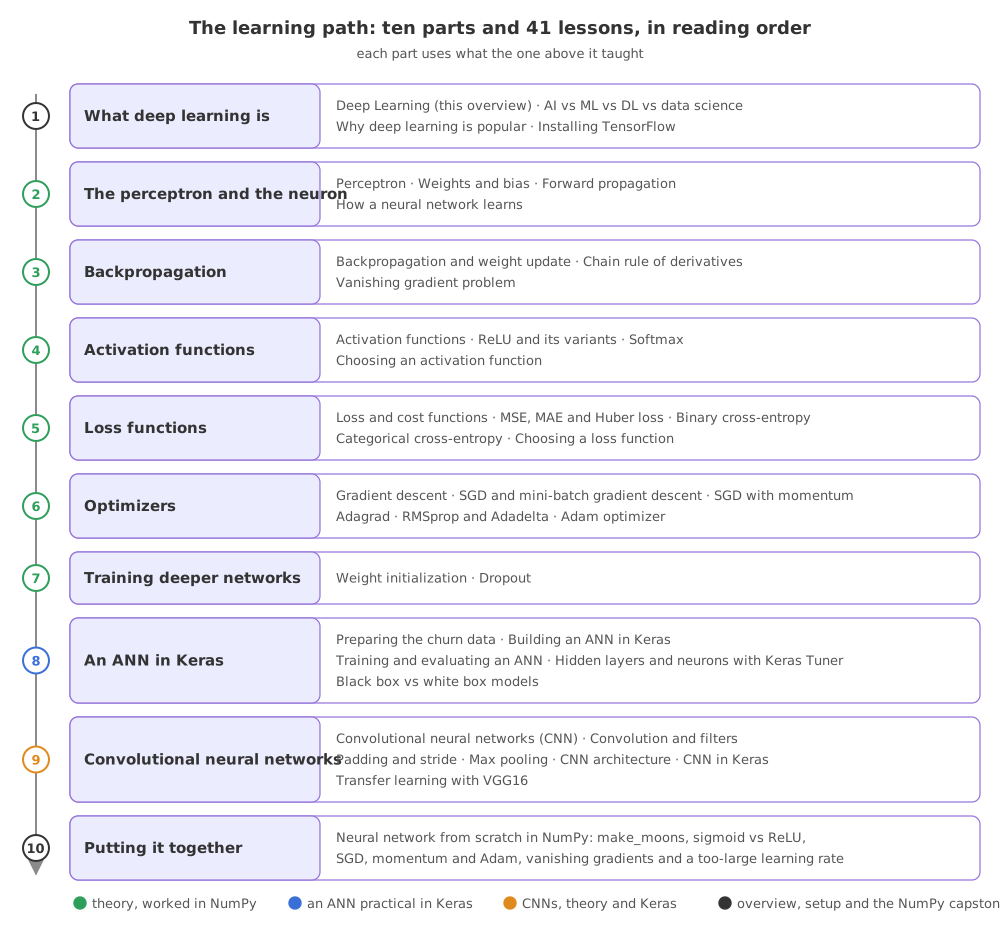
The theory parts come first because the practicals use every piece of them: a Keras Dense layer is the weighted sum and activation, compile takes a loss and an optimizer, and fit runs forward and backward passes. The table lists every lesson, part by part.
| Part | Lessons | Starts with |
|---|---|---|
| 1. What deep learning is | Deep Learning · AI vs ML vs DL vs data science · Why deep learning is popular · Installing TensorFlow | AI vs ML vs DL vs data science |
| 2. The perceptron and the neuron | Perceptron · Weights and bias · Forward propagation · How a neural network learns | Perceptron |
| 3. Backpropagation | Backpropagation and weight update · Chain rule of derivatives · Vanishing gradient problem | Backpropagation and weight update |
| 4. Activation functions | Activation functions · ReLU and its variants · Softmax · Choosing an activation function | Activation functions |
| 5. Loss functions | Loss and cost functions · MSE, MAE and Huber loss · Binary cross-entropy · Categorical cross-entropy · Choosing a loss function | Loss and cost functions |
| 6. Optimizers | Gradient descent · SGD and mini-batch gradient descent · SGD with momentum · Adagrad · RMSprop and Adadelta · Adam optimizer | Gradient descent |
| 7. Training deeper networks | Weight initialization · Dropout | Weight initialization |
| 8. An ANN in Keras | Preparing the churn data · Building an ANN in Keras · Training and evaluating an ANN · Hidden layers and neurons with Keras Tuner · Black box vs white box models | Preparing the churn data |
| 9. Convolutional neural networks | Convolutional neural networks (CNN) · Convolution and filters · Padding and stride · Max pooling · CNN architecture · CNN in Keras · Transfer learning with VGG16 | Convolutional neural networks (CNN) |
| 10. Putting it together | Neural network from scratch in NumPy | Neural network from scratch in NumPy |
Building a network from scratch at the end
The last lesson puts every theory piece into one NumPy program. A network with 2 inputs, two hidden layers of 16 neurons and a sigmoid output learns scikit-learn's make_moons, two half circles that no straight line separates, with the weight initialization, forward pass, binary cross-entropy, backpropagation and optimizer each written out by hand. The same program then compares sigmoid and ReLU hidden layers, trains with SGD, momentum and Adam, and shows two failures with real output: the gradients vanishing in a deep sigmoid network, and the loss blowing up with a learning rate that is too large. Neural network from scratch in NumPy also lists what comes after this course: RNNs, LSTMs, transformers and more.
Who this course is for
- Learners who finished machine learning and want to know what a neural network does inside, not only which Keras call to make.
- Interview preparation. The video was recorded for interviews and its standard questions appear in the lessons: "what is the difference between AI, ML and DL?", "why is deep learning becoming popular?", "why do we add a bias?", "what is the vanishing gradient problem?".
- Practitioners who have trained a Keras model and want the maths behind the loss, the optimizer and the layer sizes they picked.
Preparing what you need
- The Machine Learning course first. Machine Learning covers what this course builds on: Simple linear regression (the neuron's weighted sum is its line), Logistic regression (one neuron with a sigmoid is a logistic regression), Gradient descent and Train and test split. The video asks for at least one algorithm: "if linear regression also you know that is more than sufficient".
- Python basics: variables, lists, functions, loops, importing a library, and a first look at NumPy arrays.
- School maths: y = mx + c, powers of e, and the idea of a slope. Derivatives and the chain rule are explained where they appear, in Chain rule of derivatives.
- Python 3.12 or 3.13 on Windows, macOS or Linux, or Google Colab in a browser. Installing TensorFlow walks through each. A GPU helps for the CNN practical but no lesson needs one.
Following the video and its notes
The lessons follow Deep Learning Indepth Tutorials In 5 Hours (May 2022, 5 hours 42 minutes), recorded from a series of live sessions. The theory is drawn by hand on a digital board, day by day, and the practicals run in Google Colab.
The video's description links its materials, which serve as the notes for this course: the Complete Deep Learning folder of The Grand Complete Data Science Materials on GitHub. It holds PDF notes for every topic, from the perceptron to CNNs, and they cover what the video skips or only mentions: the worked forward pass with real weights, the step function, linear separability, the families of networks, weight initialization and dropout.
TensorFlow has changed since 2022. Where a clip or a notebook shows an older form, a line under it names the change:
| The video and its notebooks (2022) | TensorFlow 2.21 / Keras 3.15 |
|---|---|
pip install tensorflow-gpu | No new releases since December 2022, and the newest version on PyPI is an empty package that stops the install; tensorflow itself has GPU support, and tensorflow[and-cuda] brings the CUDA libraries on Linux |
| Keras 2 inside TensorFlow 2.8 | Since TensorFlow 2.16, tf.keras is Keras 3, the separate keras package |
Conv2D(..., input_shape=(32, 32, 3)) as the first layer | Still runs but warns; Keras 3 prefers keras.Input(shape=(32, 32, 3)) as the first entry of a Sequential model |
model.fit_generator(...) | Removed in Keras 3; model.fit takes the same data |
import kerastuner | The package is keras_tuner |
| A GPU on native Windows | Ended with TensorFlow 2.10; use WSL2 for a GPU on Windows |
Related
- Next: AI vs ML vs DL vs data science
- Then: Installing TensorFlow
- Prerequisite: Machine Learning
- Notes: the Complete Deep Learning materials on GitHub
- Reference: the Keras guide on tensorflow.org
Every expert started right here.