LLMOps is the set of practices for taking an application built on a large language model from a notebook to production and keeping it healthy there: planning, data, model selection, the build, evaluation, prompt engineering, deployment and monitoring, over a tools layer that carries version control, observability and cost.
Last updated: 15 Oct, 2026 · LLMOps
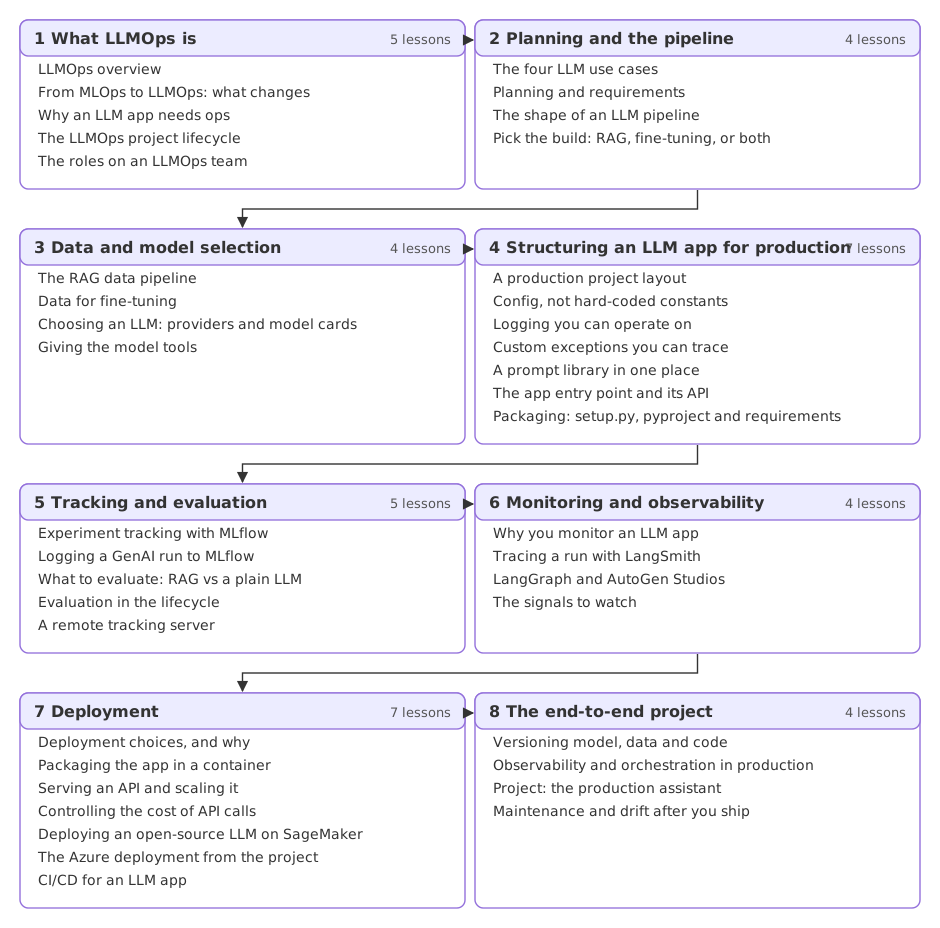
The name is LLM plus ops, the same way MLOps is machine learning plus operations. The difference is the thing being operated. Here it is a model you call as an API, fine-tune, or wrap in an agent or a retrieval pipeline, and the job is to run it reliably, cheaply and accountably once real users depend on it. This course teaches the lifecycle the LLMOps Project Lifecycle video lays out, stage by stage, and builds one running example along the way.
What you will build
One example grows through the course: a shop support assistant backed by retrieval. It begins as a plan, becomes a project with config, logging, typed errors, a prompt library and an API, then gets experiment tracking and evaluation with MLflow, observability, a deployment path and the cost and drift checks you run after shipping. The hands-on parts run on a keyless stand-in model and local MLflow, so you can follow every runnable lesson with no API key and no GPU. Fine-tuning and cloud deployment are shown against real projects and named honestly as needing hardware or an account.
How this course runs. It is concept-first. Most lessons teach a lifecycle stage with prose, a diagram and a comparison, and carry no code, because the point is the practice, not a snippet. The two runnable parts, the production project skeleton and MLflow tracking, run locally on a stand-in model with no key. Fine-tuning, SageMaker and Azure deployment, and LangSmith traces are shown as code with one line on what each needs (a GPU, an account, a key) and no invented output. No model downloads, no keys.
 LLMOps overview