
Swapping the stand-ins for the real thing
Every runnable piece of this course is a stand-in, chosen so the lessons need no key, no GPU and no account. Each one has a real counterpart that drops into the same seam: a provider call, a vector store, a judge metric and a database-backed tracking store.
Last updated: 15 Oct, 2026 · LLMOps
Maintenance and drift after you ship closed the loop on an app that is live. This lesson is the hand-over from the course's version of that app to yours. Nothing about the shape changes: the config, the prompt library, the run record and the gate all stay where they are, and four pieces behind them get replaced one at a time.
The four stand-ins, and what replaces each
| What you used | A real one | The package |
|---|---|---|
call_api, a keyword matcher over a handbook dict | A provider call, or a gateway in front of several | litellm, or langchain-openai |
HANDBOOK, a dict looked up by keyword | A vector store the retriever queries | langchain-chroma, or faiss-cpu |
faithfulness, the share of reply words found in the context | A judge metric, scored by a model | deepeval, or ragas |
file:./mlruns, a folder on your machine | A database backend, or a hosted server | mlflow with a SQLAlchemy URI |
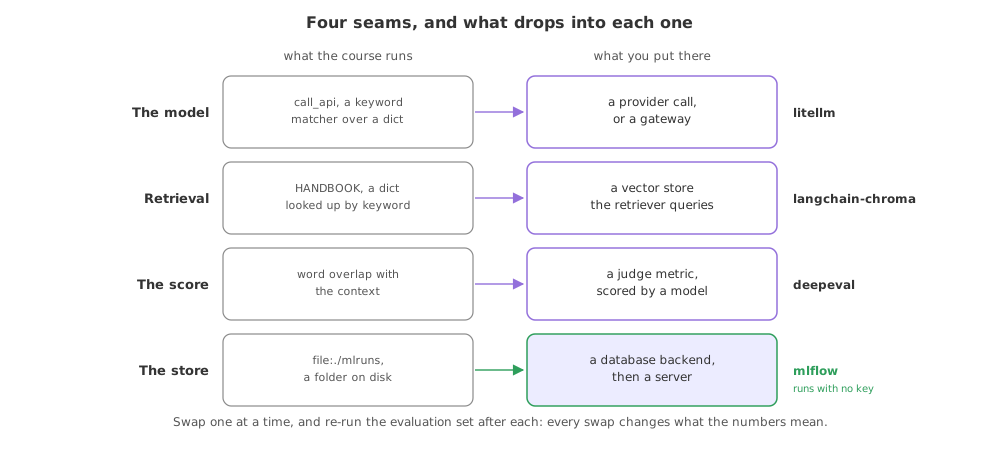
The first three need a key, so they are named here rather than run. The fourth needs nothing, so it is the one you can swap right now.
The swap you can run: a database-backed store
Syntax: the tracking URI is the only line that changes. A SQLAlchemy URI puts the same runs in a database file instead of a folder tree, which is what the MLflow project recommends for anything that outlives a lesson, and every logging call stays identical.
import os
os.environ["MLFLOW_DISABLE_AGENT_HINT"] = "1"    # hush MLflow's agent hint while you learn
import shutil
shutil.rmtree("mlruns", ignore_errors=True)      # start from an empty store
if os.path.exists("mlflow.db"):
    os.remove("mlflow.db")                       # and from an empty database

import mlflow
# the one line that changes: a database URI in place of file:./mlruns
mlflow.set_tracking_uri("sqlite:///mlflow.db")
mlflow.set_experiment("shop-assistant")

# every call below is the one you already wrote
with mlflow.start_run(run_name="on-sqlite"):
    mlflow.log_param("model", "shop-stand-in")
    mlflow.log_metric("answer_length", 8)

runs = mlflow.search_runs(experiment_names=["shop-assistant"])
print("backend :", mlflow.get_tracking_uri())
print("runs    :", len(runs))
print("db file :", os.path.exists("mlflow.db"))
backend : sqlite:///mlflow.db
runs    : 1
db file : True
What the swap showed
- Only the URI moved.
start_run,log_param,log_metricandsearch_runsare the same calls against a different backend, which is what makes this a seam rather than a rewrite. - The runs survive a folder delete, because they are rows in
mlflow.dbrather than files undermlruns/. - It is the step before a server. A hosted backend, the subject of A remote tracking server, is the same change again with an HTTPS URI and a token.
Swapping the other three
- The model.
call_apitakes a prompt and returns a string, so a provider call replaces its body, and the call sites do not move. Routing it through a gateway buys retries, fallbacks and one place to see the spend: LiteLLM overview. - Retrieval. The handbook dict stands where a retriever goes. Replacing it means the indexing path from The RAG data pipeline built for real, with the embedding model pinned as part of the index.
- The score. Word overlap is a stand-in for a judge. A real metric calls a model and returns a score with a reason: DeepEval overview and RAGAS overview both plug into the same gate.
- Swap one at a time. Each replacement changes what the numbers mean, so change one, re-run the evaluation set, and keep the run that proves the new piece did not make things worse.
Related
- Previous: Maintenance and drift after you ship
- See also: Project: the production assistant
- See also: A remote tracking server
- Point the tracking URI at
sqlite:///mlflow.dbin the capstone and confirm its runs land in the database. - Replace
call_api's body with a provider call behind a gateway and re-run the capstone's two questions. - Swap the word-overlap score for a judge metric and note which of the two questions changes verdict.
Every expert started right here.