
The LLMOps project lifecycle
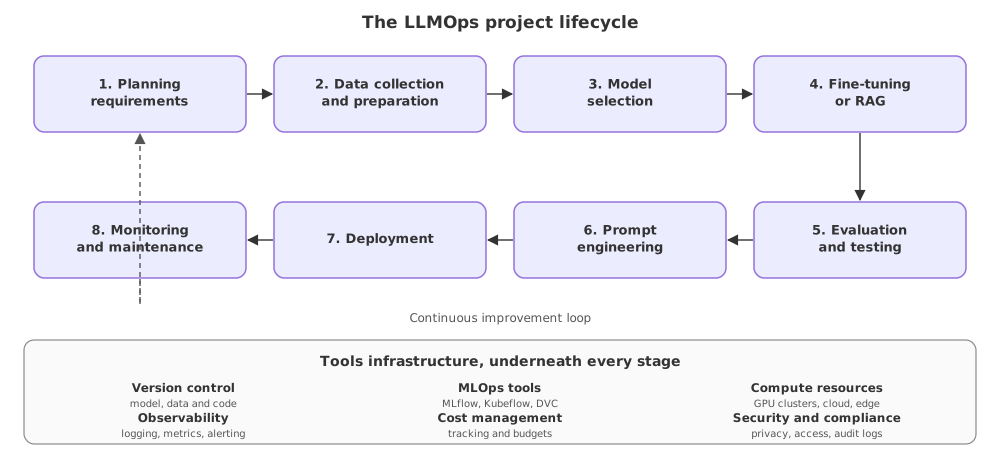
The LLMOps lifecycle is eight stages, from planning through data, model selection and the build, to evaluation, prompt engineering, deployment and monitoring, drawn as a loop that returns to the start. Under all eight sits a tools layer. It is the spine this whole course follows, one part per group of stages.
Last updated: 15 Oct, 2026 · LLMOps
Why an LLM app needs ops argued why the operational work matters. This lesson lays out the map for all of it. These eight stages are the breakdown in the LLMOps Project Lifecycle video, numbered on its board in the order it walks them, and every later part of the course is one of these stages taught in depth.
The eight stages
- Planning and requirements. Decide the use case and what success means, with the product owner and business analyst gathering requirements.
- Data collection and preparation. Gather the data the use case needs, either documents to embed for retrieval or example pairs for fine-tuning.
- Model selection. Pick the LLM. Try several providers, weigh size and cost from the model's card, and decide whether you also need external tools or MCP.
- Fine-tuning or RAG. Fine-tune the model, build a retrieval pipeline, or combine them. The video names the combination RAG with fine-tuning, also called RAFT.
- Evaluation and testing. Score the application. Retrieval and a plain LLM use different metrics, alongside A/B testing and bias detection.
- Prompt engineering. Iterate the prompt, trying several versions until the output is right. The video treats this as a loop you repeat, not a single step.
- Deployment. Set up infrastructure, an API and scaling, on a cloud or in your own, and control the cost of the API calls.
- Monitoring and maintenance. Watch the running app, trace failures and keep it healthy as data and usage shift, with tools such as MLflow and LangSmith, and the studios for agent apps.
Under all eight the video draws a second band it calls the tool infrastructure: version control for the model, the data and the code, MLOps tools such as MLflow, Kubeflow and DVC, compute resources, observability, cost management, and security and compliance. These are not a ninth stage. They are the layer every stage runs on, which is why versioning is taught near the end of this course rather than as a step in the middle of it.
The data stage branches early
The video is careful that data preparation serves two different builds. For retrieval it is an ingest pipeline: ingest the documents, parse them, split them into a document structure, chunk them, turn the chunks into vector embeddings, store those in a vector database and build a retriever over it. For fine-tuning it is instead the examples you retrain the model on. Which branch you take is decided at the build stage, and sometimes you take both.
How the stages map to this course
| Stage | Taught in |
|---|---|
| Planning, use cases, the pipeline | The four LLM use cases |
| Data and model selection | The RAG data pipeline |
| Build and project structure | A production project layout |
| Evaluation and tracking | Experiment tracking with MLflow |
| Monitoring and maintenance | Why you monitor an LLM app |
| Deployment | Deployment choices, and why |
| Maintenance and versioning | Versioning model, data and code |
Where the lifecycle guides you
- Scoping a project, where the stages become a checklist so no step, from evaluation to versioning, is skipped by accident.
- Reviewing someone else's LLM app, where you can ask which stage each gap belongs to rather than guessing.
- Planning a team's work, where each stage maps to an owner and a deliverable, which the next lesson sets out.
Related
- Previous: Why an LLM app needs ops
- Next: The roles on an LLMOps team
- Write the eight stages down the side of a page and note, for a project you know, who would own each one.
- For one app, mark which build it uses: retrieval, fine-tuning, or both, and trace the data stage that feeds it.
- Watch the lifecycle video once and check the order of the stages against the list here.
Slow is fine. Stopping is the only problem.