
1
Curious builder0 XP earned · 300 to level 2
0 daysFinish a lesson to begin
Badge collection0 of 6 unlocked
41 small wins to finish your pathNext lesson →
The roles on an LLMOps team
An LLMOps project is a team effort, and each lifecycle stage has an owner: the product owner and business analyst scope it, data people prepare the data and build, and ML and ops engineers evaluate, deploy and run it.
Last updated: 15 Oct, 2026 · LLMOps
The LLMOps project lifecycle laid out the eight stages. This lesson puts people against them. The LLMOps Project Lifecycle video names roles as it walks the stages, and the pattern is that different stages are owned by different people rather than one person carrying the whole pipeline.
Who owns which stage
- Product owner. Owns planning and requirements, and the call on what the application is for and what success means.
- Business analyst. Works alongside the product owner on requirements gathering, turning a business need into something the team can build against.
- Data scientist, data engineer and data analyst. Own data collection and preparation, and shape the build, whether that is a retrieval pipeline or a fine-tuning set, against the use case.
- ML engineer. Owns the model work: fine-tuning or the retrieval build, prompt iteration and the evaluation metrics that score the result.
- Ops engineer. Owns deployment, the API and scaling, monitoring and the cost of API calls, on a cloud or in the company's own infrastructure.
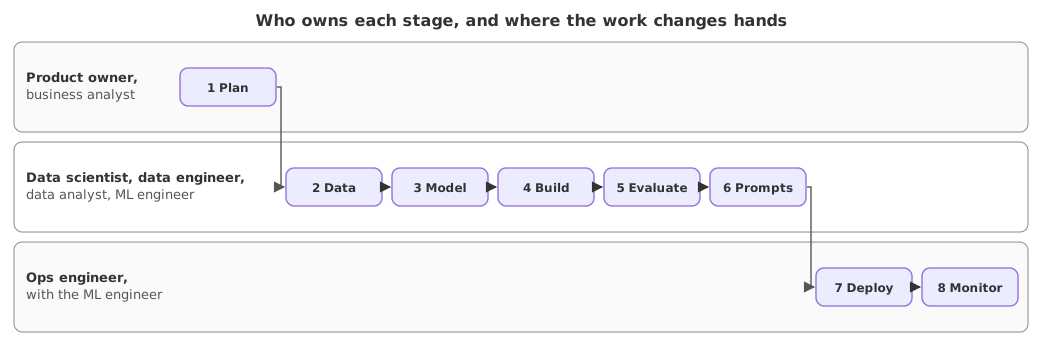
Roles against the lifecycle
| Stage | Who leads |
|---|---|
| Planning and requirements | Product owner, business analyst |
| Data collection and preparation | Data scientist, data engineer, data analyst |
| Model selection and build | ML engineer, data scientist |
| Prompt engineering and evaluation | ML engineer |
| Deployment and scaling | Ops engineer |
| Monitoring, maintenance, versioning | Ops engineer, ML engineer |
Where the roles matter
- Staffing a project, where the stages tell you which skills you need and which stage is unowned today.
- Handing work across a boundary, where knowing that data people pass a build to an ML engineer, who passes a deployed app to ops, sets the seams to watch.
- A small team wearing several hats, where one person may cover many roles but still has to do each stage's job, not skip it.
Watch out. On a small team one person often plays several of these roles at once. That is fine as long as every stage still has an owner. The failure is a stage with no owner at all, which is how evaluation or versioning quietly gets skipped.
Related
- Previous: The LLMOps project lifecycle
- Next: The four LLM use cases
Try it yourself
- For a project you know, write each lifecycle stage and the name of the person who owns it today.
- Mark any stage with no clear owner and decide who would take it.
- Watch the lifecycle video and list every role it names as it moves through the stages.
This is what real progress feels like.