
Pick the build: RAG, fine-tuning, or both
The build decision is whether to give a model your knowledge at query time with RAG, bake it into the weights with fine-tuning, or do both with RAFT.
Last updated: 15 Oct, 2026 · LLMOps
The shape of an LLM pipeline showed where the model and the data sit in the flow. This lesson is the decision at the build stage of the lifecycle: how your own knowledge reaches the model. The video lays out three routes.
The three routes
The lifecycle video describes each route by what it does to the model and the data.
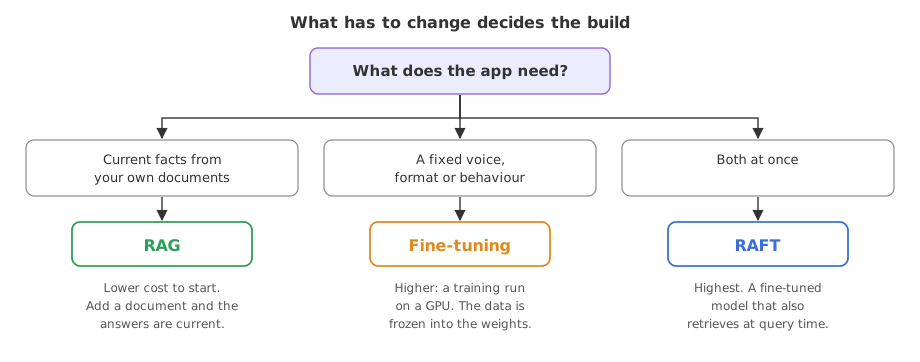
- RAG. You convert your documents into vectors, store them in a vector database, and retrieve the right passage at query time so the model answers from it. The model's weights never change; you change what you put in front of it.
- Fine-tuning. You adjust the model itself on your data, which the video describes as retraining or fine-tuning the LLM so it behaves the way your company wants. The work is a training run: hyperparameter tuning, a training pipeline, and experiment tracking.
- RAFT, which is both. The video names the combination of fine-tuning with RAG. You fine-tune a model and also retrieve from your documents, so the model learns your style while still reading current, specific facts.
The tradeoffs that decide it
Three tradeoffs separate the routes. RAG is cheaper to start and keeps answers current, because adding a document updates knowledge with no training. Fine-tuning changes how the model answers, which RAG cannot do, but costs a training run and goes stale as your data moves on. RAFT buys both and pays for both.
| RAG | Fine-tuning | RAFT (both) | |
|---|---|---|---|
| Changes the model | No | Yes | Yes |
| Cost to start | Lower | Higher (a training run) | Highest |
| Keeps answers current | Yes, add a document | No, data is frozen in | Yes, through retrieval |
| Controls the answering style | Weakly, through the prompt | Strongly | Strongly |
| Fits when | Knowledge changes often | Behaviour must change | You need both |
Where you use each route
- RAG, for a support assistant that must answer from policies and docs that change, where you cannot retrain every week.
- Fine-tuning, when the model must answer in a fixed voice or format a prompt cannot hold reliably.
- RAFT, when a project needs the fixed voice of fine-tuning and the current facts of retrieval at once.
Related
- Previous: The shape of an LLM pipeline
- Next: The RAG data pipeline
- See also: Data for fine-tuning and Choosing an LLM: providers and model cards
- Reference: the krishnaik06 channel on YouTube
- For a shop assistant that answers from a changing return policy, decide which route fits and say why in one line.
- Name one requirement that would push you from RAG to fine-tuning.
- Read The RAG data pipeline to see the data work RAG needs, then skim Data for fine-tuning for the training-set side.
Slow is fine. Stopping is the only problem.