
Evaluation in the lifecycle
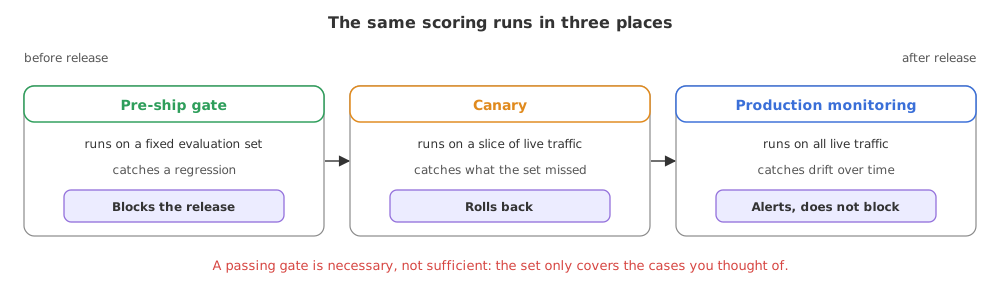
Evaluation in the lifecycle is not a one-time step: the same scoring runs as a gate before you ship, on a slice of live traffic as a canary, and continuously once the app is in production.
Last updated: 15 Oct, 2026 · LLMOps
The What to evaluate: RAG vs a plain LLM lesson chose the metrics. This lesson places them in time. The LLMOps lifecycle video puts evaluation and testing right before prompt engineering and deployment, and lists performance metrics, A/B testing and bias detection as part of it; the score it produces is what decides whether the app moves forward.
Three places evaluation runs
- A pre-ship gate. Before a change is deployed, the evaluation set runs and the change ships only if the scores hold. This is where a regression is caught cheaply, before any user sees it.
- A canary. The new version serves a small slice of real traffic while its scores are watched, so a problem the fixed evaluation set missed shows up on a few users rather than everyone.
- Production monitoring. Scores keep being computed on live answers, because a model and its inputs drift, and an app that passed last month can fail today.
A/B testing and bias detection
Two of the checks the video names sit across these placements. A/B testing runs two versions against the same traffic or the same evaluation set and compares their scores, which is how you prove a prompt change helped rather than assuming it. Bias detection checks whether answers differ unfairly across groups, a safety metric you run before shipping and keep running in production.
Offline evaluation vs production monitoring
| Pre-ship gate | Canary | Production monitoring | |
|---|---|---|---|
| Runs on | A fixed evaluation set | A slice of live traffic | All live traffic |
| Catches | A regression | What the set missed | Drift over time |
| Blocks a release | Yes | Rolls back | Alerts, does not block |
| Cost if it fails | None, nothing shipped | A few users | Caught early in the open |
Where you use evaluation in the loop
- A continuous integration check, running the evaluation set on every change so a drop in score fails the build.
- A staged rollout, where the canary's scores decide whether the new version takes more traffic or rolls back.
- A monitoring dashboard, tracking production scores so drift is seen as it starts, not after complaints.
Related
- Previous: What to evaluate: RAG vs a plain LLM
- Next: A remote tracking server
- Automating the gate: Promptfoo overview
- Automating the gate: DeepEval overview
- Sketch where the shop assistant's evaluation set would run in a continuous integration pipeline.
- Write one A/B question for the shop assistant, naming the two versions and the metric that would decide.
- List one input the fixed evaluation set would miss that production monitoring would catch.
Slow is fine. Stopping is the only problem.