
The RAG data pipeline
The RAG data pipeline is the chain that turns your own documents into something an LLM can retrieve from at request time: ingest the source, parse it, split it into a document structure, chunk it, embed each chunk into a vector, store the vectors in a vector database, and build a retriever the app queries.
Last updated: 15 Oct, 2026 · LLMOps
The Pick the build: RAG, fine-tuning, or both lesson chose between giving a model knowledge through retrieval and baking it in by fine-tuning. When the choice is retrieval, this pipeline is the data work it commits you to. In the Detailed LLMOps Project Lifecycle video, the data chain is drawn on the board as the data collection and preparation stage for a RAG application.
The stages, in order
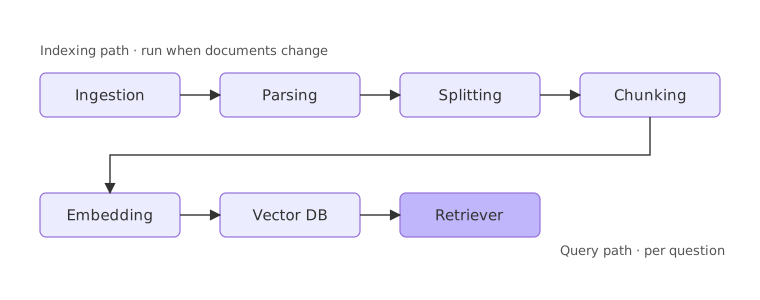
On the board the stage is a fixed sequence, each step feeding the next. The framework course writes the code for each; here the point is the shape and the order, because that order is what you re-run when anything upstream changes.
- Ingestion pulls the raw source in: files, pages, a database export, whatever the documents live as.
- Parsing reads each source into a clean document structure, stripping the format down to text and metadata.
- Splitting breaks a long document into smaller passages with a document splitter, so no single piece is too large to embed or retrieve.
- Chunking fixes the size of those passages, the unit the retriever will later return.
- Embedding converts each chunk into a vector with an embedding model, so meaning becomes a point in space.
- Storing writes the vectors into a vector database, the index the app searches.
- Retrieval builds a retriever on top of that database, which takes a question and returns the closest chunks.
The ops view: what you version, re-run and monitor
The framework course owns how to build each step. The operations question is different: every stage is something you have to version, re-run and watch. The video lists data versioning alongside model and code versioning in the lifecycle's version-control stage, and for RAG the data you version is the chunks and their embeddings.
- Version the inputs and the index. The source documents, the chunking settings and the stored vectors each have a version, so you can tell which index answered a question.
- Re-run on change. New or edited documents mean re-ingesting, re-chunking and re-embedding at least the parts that changed, then refreshing the store.
- Watch retrieval quality. The signal that matters in production is whether the retriever returns the right chunks, not whether the pipeline finished without error.
- Account for embedding cost. Embedding every chunk is a compute or API cost that grows with how much data you hold and how often you re-index.
The indexing path and the query path
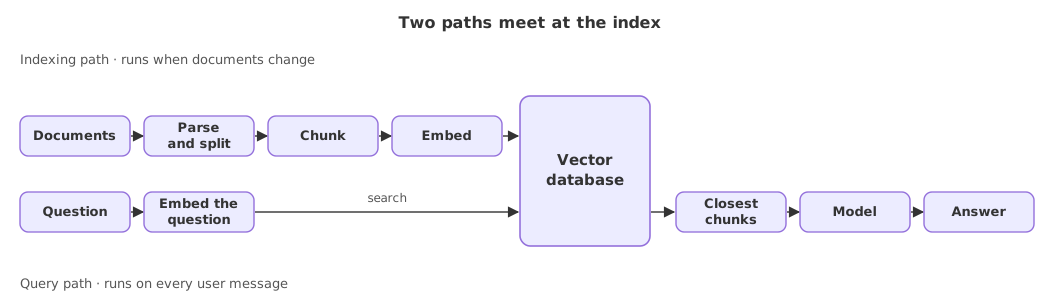
The chain splits into two paths that run on different clocks. The first six steps build the index offline; the retriever runs online, once per question.
| Indexing path | Query path | |
|---|---|---|
| When it runs | When documents change | On every user message |
| Steps | Ingest, parse, split, chunk, embed, store | Embed the question, retrieve the closest chunks |
| What you watch | Re-index time and coverage | Retrieval relevance and latency |
| What you version | The chunks and their vectors | The retriever settings, such as how many chunks to return |
Where the RAG data pipeline fits
- Any assistant answering from a private corpus, such as the shop support bot grounded in product and policy documents.
- A knowledge base that changes, where new documents must reach the index without rebuilding the whole app.
- A system that has to cite its source, which the retrieved chunk and its metadata make possible.
Related
- Previous: Pick the build: RAG, fine-tuning, or both
- Next: Data for fine-tuning
- Hands-on: Building a RAG pipeline
- See also: Embeddings and vector stores
- Take ten of your own documents and build the ingest-to-store path from the Building a RAG pipeline lesson, then query the retriever.
- For one document source, write down every stage you would re-run if the file changed tomorrow.
- Open the model card of an embedding model and note its vector dimension and its price per million tokens.
This is what real progress feels like.