
The four LLM use cases
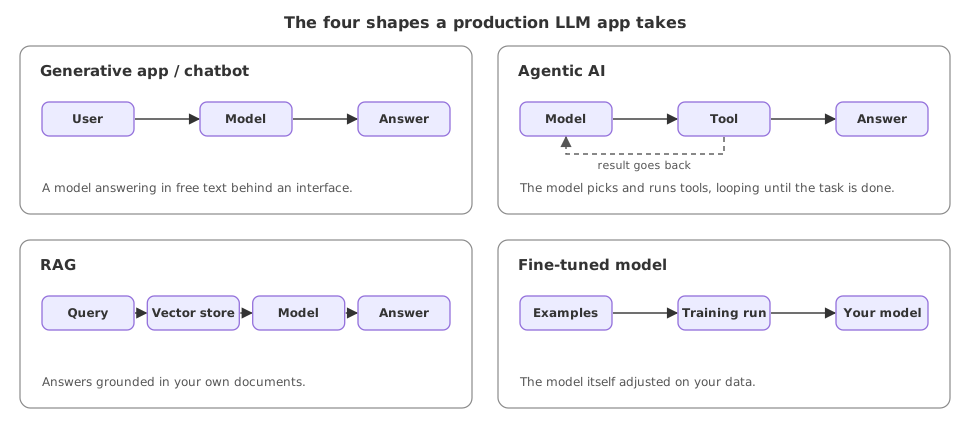
The four LLM use cases are the shapes almost every production LLM app takes: a generative AI app or chatbot, an agentic AI system, a retrieval app over your own documents, and a fine-tuned model.
Last updated: 15 Oct, 2026 · LLMOps
The roles on an LLMOps team named the people who own an LLM project. Before that team plans anything, it has to settle the shape of the thing being built, because every later stage bends to it. The Detailed LLMOps Project Lifecycle video lists four use cases that cover most of what companies ask for.
The four shapes
The video groups production work with LLMs into four recurring kinds. The first two are about letting a model act; the last two are about grounding it in knowledge it was not trained on.
- A generative AI app or chatbot. An interface with a model behind it that answers in free text. The video calls this the most common starting point: a chatbot with an LLM integrated into it.
- An agentic AI system. A model that chooses and runs tools to carry out a multi-step task, rather than only replying. The video frames this as building your own AI agent to perform a specific job.
- A retrieval app (RAG). The model answers from your own documents, which are stored as vectors in a vector database and fetched at query time. The video singles this out as the use case it sees most often.
- A fine-tuned model. You adjust the model itself on your data so it answers the way your organisation needs, instead of steering it only with a prompt.
The board in the clip writes five lines rather than four: it separates agentic AI application from AI agents, and lists fine-tuning last. This page treats an agent and an agentic system as one shape, which is how the rest of the course uses the word, and counts fine-tuning as the fourth.
What drives the choice
The use case is not a style preference. It decides what data you collect, which stage of the lifecycle does the heavy lifting, and what you measure at the end. A chatbot leans on prompt work and a model API. A retrieval app needs a document pipeline and a vector store. A fine-tuned model needs a training dataset and a training run. An agentic system needs tools the model can call safely.
| Use case | What it is | What it leans on |
|---|---|---|
| Generative AI app / chatbot | A model answering in free text behind an interface | A model API and prompt design |
| Agentic AI | A model that picks and runs tools for a task | Tools, and a way to govern the calls |
| RAG | Answers grounded in your own documents | A document pipeline and a vector store |
| Fine-tuning | The model adjusted on your data | A training dataset and a training run |
Where you use the four shapes
- Scoping a new project, where naming the use case tells the team which lifecycle stages they will spend their time in.
- Reading a requirement such as answer from our policy PDFs, which points at RAG rather than fine-tuning or a bare chatbot.
- Estimating cost and effort, since a fine-tuning project carries a training run that a retrieval app does not.
Related
- Previous: The roles on an LLMOps team
- Next: Planning and requirements
- See also: The RAG data pipeline and Pick the build: RAG, fine-tuning, or both
- Reference: the krishnaik06 channel on YouTube
- Take one app you have used and name which of the four shapes it is, then name the second shape hiding inside it.
- Write a one-line requirement for a shop support assistant and decide whether it points at RAG, fine-tuning, or a plain chatbot.
- Read The RAG data pipeline and note which use case it belongs to.
Every expert started right here.