
Planning and requirements
Planning and requirements is the first stage of the LLMOps lifecycle: before any data or model, you fix what the app is for, how you will know it works, and who owns it.
Last updated: 15 Oct, 2026 · LLMOps
The four LLM use cases gave you the shape of the thing being built. This lesson is the stage that comes before everything else in the lifecycle video, where the project is scoped and its requirements are gathered.
Who owns this stage
In the video the planning stage belongs to the product owner and the business analyst. The product owner carries the goal; the business analyst gathers the requirements. Their output is a clear statement of the use case, which the data and model work downstream is then built to serve. The video is explicit that data collection follows from the use case you are solving, so a vague scope here spreads confusion through every later stage.
What to decide before building
Three things are worth writing down before a single document is collected or a model is chosen.
- Scope. The one use case the app serves, and the questions or tasks it will handle. A support assistant that answers from your return policy is a scope; an assistant that does everything is not.
- Success criteria. How you will know it works, in numbers you can measure later: the answers it must get right, the latency a user will accept, the cost per request you can afford. These become the targets the evaluation stage checks.
- Ownership. Who signs off on the scope, who owns the data, and who is called when the deployed app misbehaves.
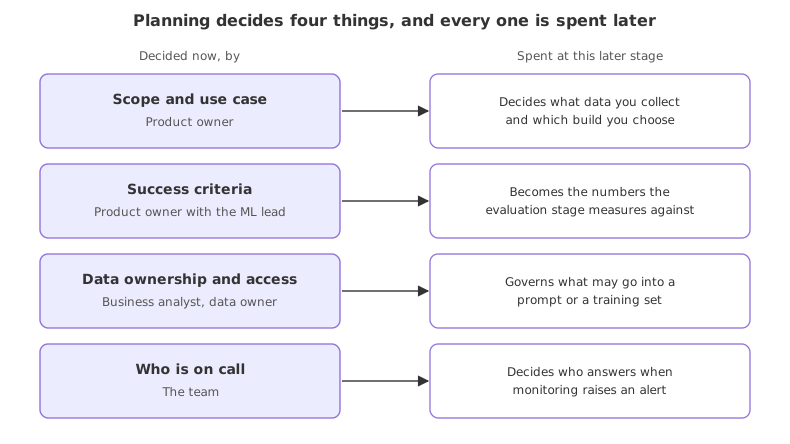
| Decision | Who answers it | Why it matters later |
|---|---|---|
| Scope and use case | Product owner | Decides what data is collected and which build is chosen |
| Success criteria | Product owner with the ML lead | Becomes the metrics the evaluation stage measures against |
| Data ownership and access | Business analyst, data owner | Governs what can go into a prompt or a training set |
| Who is on call | The team | Decides who responds when monitoring raises an alert |
Where you use planning
- Starting a project, where an hour spent on scope saves weeks of collecting the wrong data.
- Settling a disagreement, where a written success criterion ends an argument about whether the app is good enough.
- Handing over to evaluation, where the criteria you wrote become the pass marks a later stage checks.
Related
- Previous: The four LLM use cases
- Next: The shape of an LLM pipeline
- See also: The LLMOps project lifecycle and What to evaluate: RAG vs a plain LLM
- Write a one-sentence scope for a shop support assistant, naming the single use case it serves.
- Set three success criteria for it as numbers: an accuracy target, a latency a user will accept, and a cost per request.
- List who owns the scope, who owns the data, and who is called when it breaks.
Little by little, you're building something great.