
What to evaluate: RAG vs a plain LLM
What you evaluate depends on the app: a RAG system is scored on whether its answer is grounded in what it retrieved, while a plain LLM is scored on whether its answer is correct and appropriate.
Last updated: 15 Oct, 2026 · LLMOps
The Logging a GenAI run to MLflow lesson recorded a faithfulness score without saying why that score and not another. The LLMOps lifecycle video says the evaluation step uses different metrics for a RAG application than for a simple LLM model, and that both sets can apply. This lesson names the two metric families so you pick the right ones before you log anything.
Why the two differ
A RAG app has two moving parts that can each go wrong: the retrieval step that fetches context, and the generation step that writes an answer from it. A plain LLM has only the generation step. So RAG needs metrics that judge the retrieved context as well as the answer, while a plain LLM is judged on the answer alone.
The RAG metric family
- Faithfulness asks whether the answer is supported by the retrieved context, not invented. A low score is a hallucination on top of good or bad retrieval.
- Context precision asks whether the retrieved chunks were relevant, rather than padding that crowds out the useful text.
- Context recall asks whether retrieval found all the context the answer needed, so a correct question is not failed by a missing document.
The plain-LLM metric family
- Correctness compares the answer against a reference or ground truth, the comparison made in the MLflow video.
- Relevance asks whether the answer addresses the question, rather than being true but off-topic.
- Toxicity and safety ask whether the answer contains harmful or disallowed content, a metric the MLflow video logs directly.
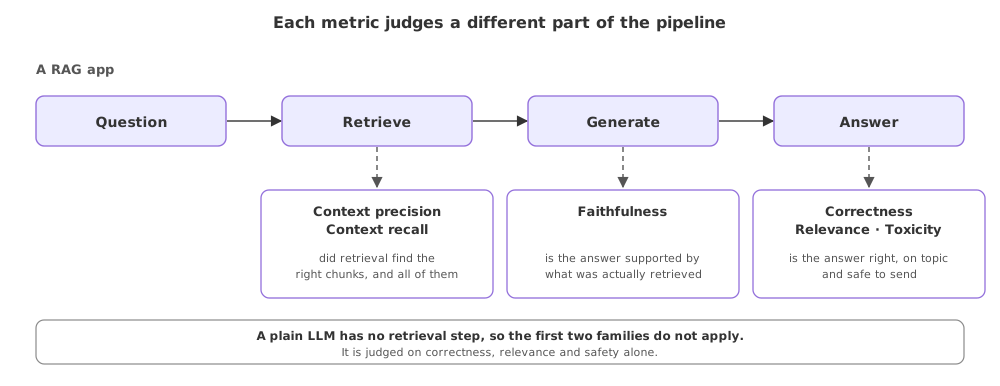
RAG metrics vs plain-LLM metrics
| RAG app | Plain LLM | |
|---|---|---|
| Judges retrieval | Yes, precision and recall | No retrieval step |
| Judges grounding | Faithfulness to the context | Not applicable |
| Judges the answer | Correctness and relevance | Correctness and relevance |
| Judges safety | Toxicity | Toxicity |
Where you use each family
- The RAG family for the shop assistant answering from a document store, where a wrong answer usually traces to bad retrieval.
- The plain-LLM family for a summariser or classifier with no retrieval, where only the output is in question.
- Both families when a RAG app also has to stay safe and on-topic, so you add the answer and safety metrics to the retrieval ones.
Related
- Previous: Logging a GenAI run to MLflow
- Next: Evaluation in the lifecycle
- The graders themselves: Promptfoo overview
- The graders themselves: DeepEval overview
- List the shop assistant's failure modes and label each as a retrieval problem or a generation problem.
- Read the metric list in Promptfoo overview and match each grader to the RAG or plain-LLM family.
- Pick three metrics you would log for the shop assistant and write one sentence on what each would catch.
You understood something today that you didn't yesterday.