
The Azure services the project runs on
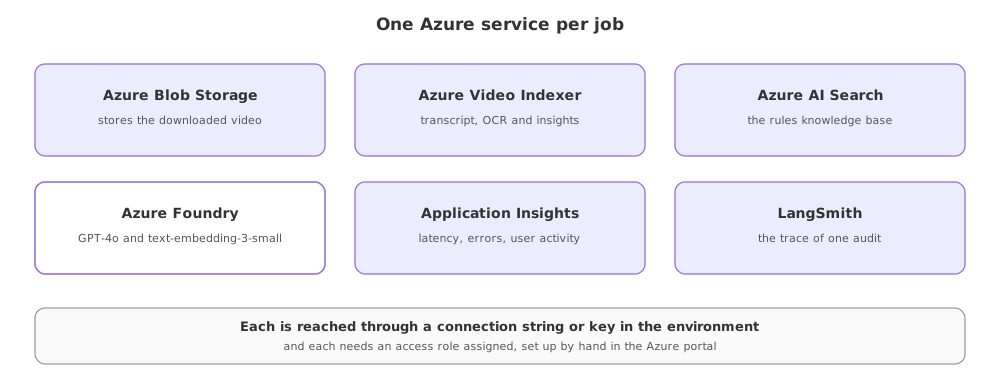
BrandGuardian is assembled from managed Azure services, one per job: Blob Storage for the video, Video Indexer to read it, AI Search for the rules, Foundry for the model and the embeddings, and Application Insights to watch it all. Each is provisioned once and reached through a connection string in the environment.
Last updated: 15 Oct, 2026 · LLMOps
The project: a video compliance auditor drew the architecture. This lesson names the services behind each box, because the first real work of the project is provisioning them and putting their credentials in one place.
One service per job
| Service | Its job in the project |
|---|---|
| Azure Blob Storage | Stores the unstructured data: the downloaded video itself. |
| Azure Video Indexer | Reads the video: transcript, on-screen text by OCR, and insights. |
| Azure AI Search | The knowledge base: the vector store the FTC rules are embedded into. |
| Azure Foundry / Azure OpenAI | The model: GPT-4o as the auditor, and text-embedding-3-small for the rules. |
| Azure Application Insights | The monitor: latency, errors and user activity across every request. |
| LangSmith | The trace: the chain of thought for one audit, request by request. |
The model, from Foundry
The video deploys two models in Azure Foundry: GPT-4o, which it calls the brain of the system, as the auditor, and text-embedding-3-small to turn the rule documents into vectors. Both are named deployments; the app reads the endpoint, the key and the deployment name from the environment rather than hard-coding them, the same pattern as Config, not hard-coded constants.
# the model, from Foundry
AZURE_OPENAI_ENDPOINT=...
AZURE_OPENAI_API_KEY=...
AZURE_OPENAI_CHAT_DEPLOYMENT=gpt-4o
AZURE_OPENAI_EMBEDDING_DEPLOYMENT=text-embedding-3-small

# the knowledge base and the storage
AZURE_SEARCH_ENDPOINT=...
AZURE_SEARCH_API_KEY=...
AZURE_SEARCH_INDEX_NAME=brand-compliance-rules
AZURE_BLOB_CONNECTION_STRING=...

# reading the video, and watching the app
AZURE_VIDEO_INDEXER_ACCOUNT_ID=...
APPLICATIONINSIGHTS_CONNECTION_STRING=...
LANGCHAIN_API_KEY=...
LANGCHAIN_PROJECT=brand-guardian
Related
- Previous: The project: a video compliance auditor
- Next: The knowledge base: rules into Azure AI Search
- Match each of the six services to the lifecycle stage it serves, from data to monitoring.
- Name which two services would keep billing if you forgot to tear them down.
You understood something today that you didn't yesterday.