AI vs ML vs DL vs data science
Artificial intelligence (AI) is the field that builds applications which do their task without human intervention; machine learning (ML) is the part of AI that learns from data, and deep learning (DL) is the part of ML that uses multi-layered neural networks.
Last updated: 05 Oct, 2026 · scikit-learn 1.9.1
The four names are used loosely in job titles and course names. The video sorts them with one picture, sets inside sets, and one rule: whatever the role, the end product is an AI application.
Defining an AI application
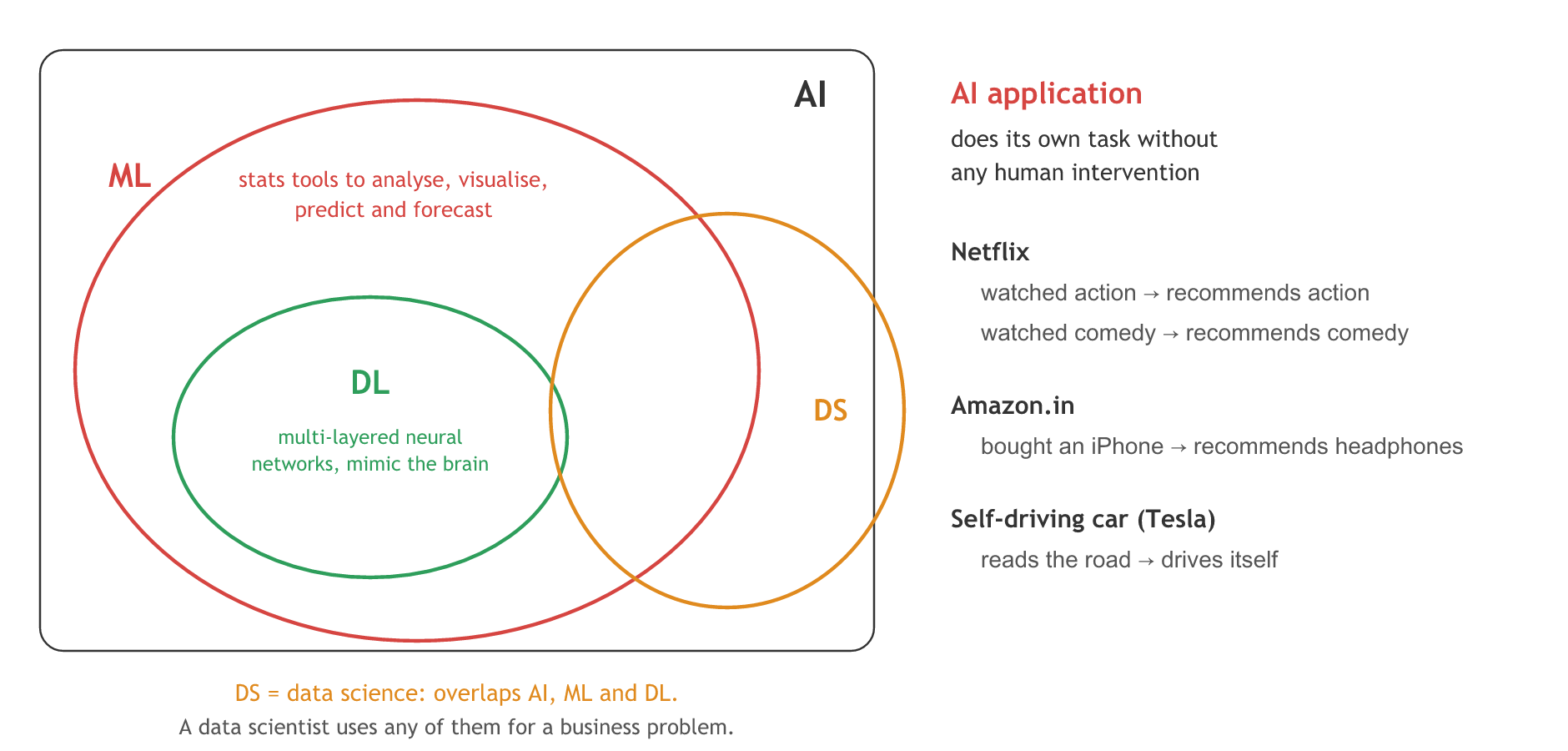
Imagine the whole universe of these applications and call it AI. An AI application does its task without any human intervention: nobody has to monitor it, it makes its own decisions and performs its task. The video gives four examples:
- Netflix. Watch action movies for a while and the recommendation module suggests more action movies. Watch comedies and it suggests comedies. It learns your behaviour without asking you anything.
- Amazon.in. Buy an iPhone and it may recommend headphones.
- YouTube ads. An AI engine chooses which ad you see. The goal is a business one.
- Self-driving cars, such as Tesla's. The car drives itself based on the road ahead.
Whatever your title, machine learning developer, deep learning developer, computer vision developer, data scientist or AI engineer, the work ends in an AI application.
Placing machine learning and deep learning inside AI
Machine learning is a subset of AI. It provides statistical tools to analyse data, visualise it, and make predictions and forecasts. The equations inside machine learning algorithms are statistical techniques, because working with data means working with statistics.
Deep learning is a subset of machine learning. In the 1950s and 60s scientists asked whether a machine could learn the way a human learns. Deep learning tries to mimic the human brain with multi-layered neural networks, and it solves very complex use cases.
Data science overlaps all three. The notes draw it as a fourth circle that cuts across AI, ML and DL. A data scientist given a business problem may solve it with machine learning or deep learning, and may first have to analyse and visualise the data. The video's own example: at Panasonic the tasks ranged from Power BI dashboards to machine learning projects to deep learning projects.
Checking the nesting with Python sets
The nesting is a statement about sets, so Python's set operators can check it. The members here are the video's own words for each layer.
ai = {"does its task without human intervention", "statistical tools", "multi-layered neural networks"}
ml = {"statistical tools", "multi-layered neural networks"}
dl = {"multi-layered neural networks"}

print("DL inside ML:", dl <= ml)
print("ML inside AI:", ml <= ai)
print("in ML but not DL:", ml - dl)
print("ML inside DL:", ml <= dl)DL inside ML: True
ML inside AI: True
in ML but not DL: {'statistical tools'}
ML inside DL: FalseReading the set checks
- dl <= ml and ml <= ai are both True: every deep learning method is a machine learning method, and every machine learning method is part of AI.
- ml - dl leaves the statistical tools: the classical algorithms in this course are machine learning but not deep learning.
- ml <= dl is False: the nesting only works one way.
AI vs ML vs DL vs data science
| Term | What it is | How it works | Example |
|---|---|---|---|
| AI | Applications that do a task without human intervention | Any method: rules, ML or DL | Netflix and Amazon.in recommendations, Tesla's self-driving |
| ML | A subset of AI that learns from data | Statistical tools to analyse, visualise, predict, forecast | The classical algorithms in this course, from linear regression to clustering |
| DL | A subset of ML | Multi-layered neural networks that mimic the brain | Very complex use cases, such as recognising images and speech |
| Data science | A role that overlaps all three | Analysis, visualisation, ML and DL as the problem needs | Power BI, ML and DL projects at Panasonic |
Where you use AI, ML and DL
- Reading job titles. An AI engineer, a data scientist and an ML developer all build AI applications; the title says which tools they reach for first.
- Choosing an approach. A table of a few thousand rows with numeric columns suits the classical machine learning in this course. Images, audio and long text usually need deep learning.
- Interviews. "What is the difference between AI, ML and DL?" is a common first question, and the nested picture answers it in one sketch.
Related
- Previous: Machine Learning
- Next: Supervised and unsupervised learning
- Add
"if-else rules written by hand"to theaiset only and printai - ml: the hand-written rules now appear next to the AI definition, AI that does not learn from data. - Write the input and output for the Netflix example (watch history in, a recommended title out), then do the same for Amazon.in.
- Name one task from your own work that an AI application could do without human intervention, and say whether it needs deep learning (images, speech) or classical machine learning (a table of numbers).
Little by little, you're building something great.