Hyperparameter tuning with GridSearchCV
Hyperparameter tuning is the search for the settings a model does not learn by itself, such as the alpha of Ridge, by scoring every candidate with cross-validation and keeping the best one.
Last updated: 05 Oct, 2026 · scikit-learn 1.9.1
Ridge regression and Lasso regression both depend on λ. GridSearchCV tries every value you list, scores each with cross-validation, and reports the winner.
The video's notebook uses load_boston(), which scikit-learn removed in 1.2; the code here uses fetch_california_housing().
Choosing what to tune
A fitted model predicts with .predict on the test values; the video notes this, then sets linear regression aside for Ridge. Two imports do the work: Ridge from sklearn.linear_model and GridSearchCV from sklearn.model_selection. The parameter to tune is alpha, the λ of "alpha multiplied by slope square". max_iter, how many times the slopes get updated, can be tuned too.
About the score: the video uses scoring="neg_mean_squared_error". scikit-learn scorers always treat a higher number as better, so the mean squared error comes back with a minus sign. A score of −37 means an MSE of 37; closer to 0 is better.
Writing the parameter grid
The grid is a dictionary: the parameter name as the key, the list of values to try as the value. The video's list runs from tiny to large: 1e-15, 1e-10, 1e-8, 1e-3, 1e-2, 1, 5, 10, 20. GridSearchCV takes the model, the grid, the scoring and cv, the number of cross-validation folds. It fits every value on every fold and keeps the best.
While writing the fit, the video adds: "you can first of all do train test split on X and Y and then probably only do this on X train and Y train". The code below does that.
The first run in the video fails: the grid is written with square brackets.
params = ['alpha': [1e-15, 1e-10, 1e-8, 1e-3, 1e-2, 1, 5, 10, 20]] File "main.py", line 1
params = ['alpha': [1e-15, 1e-10, 1e-8, 1e-3, 1e-2, 1, 5, 10, 20]]
^
SyntaxError: invalid syntaxA key and a value separated by a colon only make sense inside curly braces. "It has become a list; I'm going to make this as dictionary": params = {'alpha': [...]} fixes it.
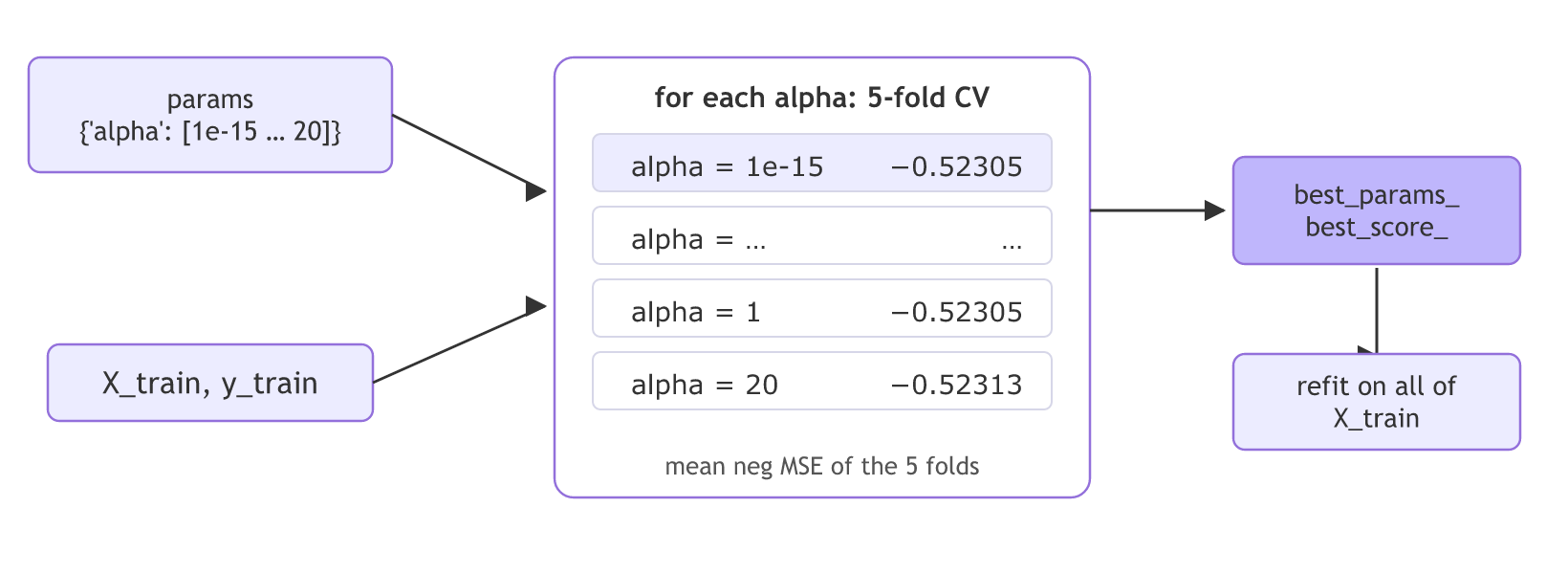
GridSearchCV
from sklearn.linear_model import Ridge
from sklearn.model_selection import GridSearchCV

params = {"alpha": [1e-15, 1e-10, 1e-8, 1e-3, 1e-2, 1, 5, 10, 20]}
ridge_regressor = GridSearchCV(Ridge(), params, scoring="neg_mean_squared_error", cv=5)
ridge_regressor.fit(X_train, y_train)      # 9 alphas x 5 folds = 45 fits, then one refit
print(ridge_regressor.best_params_)        # the winning alpha
print(ridge_regressor.best_score_)         # its mean cross-validated score
Keeping a validation set for tuning
Choosing alpha needs data the model was not fitted on, and the test set cannot be it: once alpha is picked by its test score, that score is no longer a fair check. So the data is split three ways. Out of 1,000 data points, 70% (700) become the training dataset that trains the model and 30% (300) the test dataset that tests it. The training dataset is split once more: one part trains the model, the other, the validation dataset, scores each hyperparameter value.
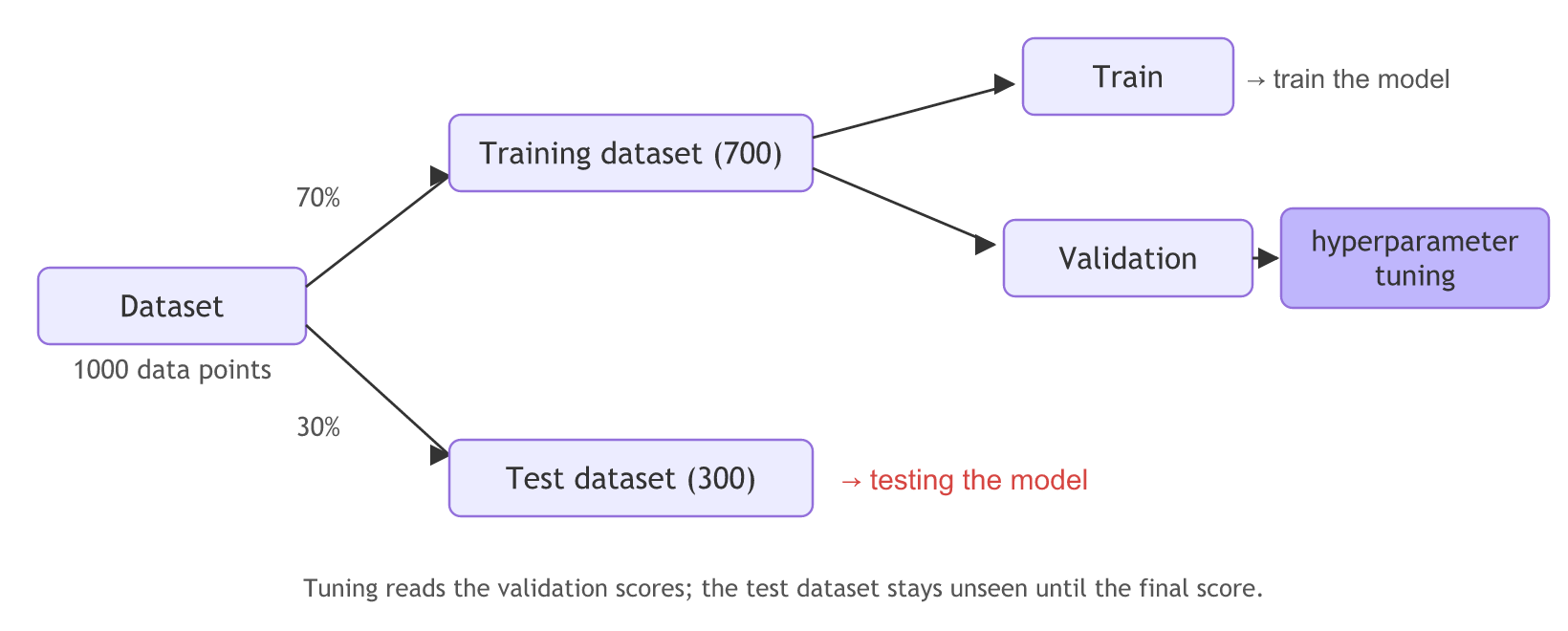
GridSearchCV makes the second split for you. With cv=5 each fold takes its turn as the validation part, so every row of X_train trains some fits and validates others, and the test set stays untouched until the final score.
Tuning Ridge and Lasso on California housing
In the video, on the Boston data: linear regression scored −37.13, Ridge picked alpha 20 at −32.38, and Lasso picked alpha 1 at −35.53. With a longer grid ending at 100, Ridge picked alpha 100 at −29.91. Those searches ran on all of X and y. Here the data is split first (as in Train and test split), the search runs on the training part only, and the test part is kept for one final score.
import numpy as np
import pandas as pd
from sklearn.datasets import fetch_california_housing
from sklearn.model_selection import train_test_split, GridSearchCV, cross_val_score
from sklearn.linear_model import LinearRegression, Ridge, Lasso
from sklearn.metrics import r2_score

X, y = fetch_california_housing(return_X_y=True, as_frame=True)
X_train, X_test, y_train, y_test = train_test_split(X, y, test_size=0.33, random_state=42)

mse = cross_val_score(LinearRegression(), X_train, y_train, scoring="neg_mean_squared_error", cv=5)
print("LinearRegression:", round(np.mean(mse), 5))

params = {"alpha": [1e-15, 1e-10, 1e-8, 1e-3, 1e-2, 1, 5, 10, 20]}
ridge_regressor = GridSearchCV(Ridge(), params, scoring="neg_mean_squared_error", cv=5)
ridge_regressor.fit(X_train, y_train)
print("Ridge:", ridge_regressor.best_params_, round(ridge_regressor.best_score_, 5))

lasso_regressor = GridSearchCV(Lasso(), params, scoring="neg_mean_squared_error", cv=5)
lasso_regressor.fit(X_train, y_train)
print("Lasso:", lasso_regressor.best_params_, round(lasso_regressor.best_score_, 5))

results = pd.DataFrame(ridge_regressor.cv_results_)[["param_alpha", "mean_test_score", "rank_test_score"]]
print(results.round({"mean_test_score": 5}).to_string(index=False))

y_pred = ridge_regressor.predict(X_test)     # the best alpha, refit on all of X_train
print("Ridge test R2:", round(r2_score(y_test, y_pred), 4))LinearRegression: -0.52305
Ridge: {'alpha': 1e-15} -0.52305
Lasso: {'alpha': 1e-08} -0.52305
param_alpha mean_test_score rank_test_score
1.000000e-15 -0.52305 1
1.000000e-10 -0.52305 1
1.000000e-08 -0.52305 3
1.000000e-03 -0.52305 4
1.000000e-02 -0.52305 5
1.000000e+00 -0.52305 6
5.000000e+00 -0.52306 7
1.000000e+01 -0.52307 8
2.000000e+01 -0.52313 9
Ridge test R2: 0.597Lasso prints ConvergenceWarning messages for the tiny alphas, as it did in the video: with alpha near 0 its solver needs more iterations. The search still finishes and the results stand.
Why the smallest alpha won
- best_params_ is the smallest alpha. Ridge picks 1e-15 and Lasso 1e-08, and both best scores equal linear regression's −0.52305 to five decimals.
- The table shows the reason. The mean score barely moves from 1e-15 to 1 and gets slightly worse at 5, 10 and 20. With 13,828 training rows and 8 slopes, a straight line does not overfit, so a penalty only adds error.
- The video saw the same once it split the data. Searching on X_train, its Ridge picked alpha 0.01 and Lasso 1e-08, both at −25.47, against −25.19 for linear regression: no better than the plain line.
- The test R² is the honest final number. 0.597 on rows the search never saw. GridSearchCV refits the best alpha on the whole training set, so
predictuses that refit model.
GridSearchCV vs cross_val_score
| cross_val_score | GridSearchCV | |
|---|---|---|
| Scores | one model with fixed settings | one model per value in the grid |
| Returns | an array of fold scores | a fitted search: best_params_, best_score_, cv_results_ |
| Refits | no | yes, the best setting on all the data it was given |
| Can predict | no | yes, with the refit best model |
| Use it for | checking one model | choosing alpha, C, max_iter, depth |
Ridge, Lasso and ElasticNet also have a search built in, RidgeCV, LassoCV and ElasticNetCV, which ElasticNet regression uses on the forest fires data.
Where you use GridSearchCV
- Choosing λ. The alpha of Ridge and Lasso, as here.
- Tuning a classifier. C and max_iter of logistic regression in Logistic regression in scikit-learn, with
scoring="f1". - Any model with settings. Tree depth, number of neighbours, number of trees: the same three lines, a different grid.
Related
- Previous: ElasticNet regression
- Next: Linear regression assumptions
- Reference: scikit-learn: Tuning the hyper-parameters of an estimator
- Add the video's longer grid,
30, 35, 40, 45, 50, 55, 100, toparamsand check whether best_params_ changes. - Set
cv=10in both searches, as the video does, and compare best_score_. - Change
scoringto"r2". The best score becomes an R², where higher is better without a minus sign.
Every expert started right here.