Instance-based vs model-based learning
Instance-based learning is a way of learning in which the model memorises the training data and answers a new case from the stored examples closest to it, while model-based learning generalises the data into a pattern, such as a formula or a decision boundary, and answers from that pattern.
Last updated: 05 Oct, 2026 · scikit-learn 1.9.1
Supervised and unsupervised learning describe the data. This split describes what a model keeps after training: the data itself, or a pattern learned from it. It decides how much a saved model weighs and how fast it answers.
Memorising versus generalising
The notes start from a use case and an ML model that solves a regression or a classification problem. How the model learns the pattern of the data can go two ways, the same two ways a person learns:
- Memorising gives instance-based learning: keep the data, and answer from it directly. The flow is data, then output.
- Generalising gives model-based learning: find the pattern in the data, turn it into a generalized model, and answer from the model. The flow is data, then pattern, then generalization method.
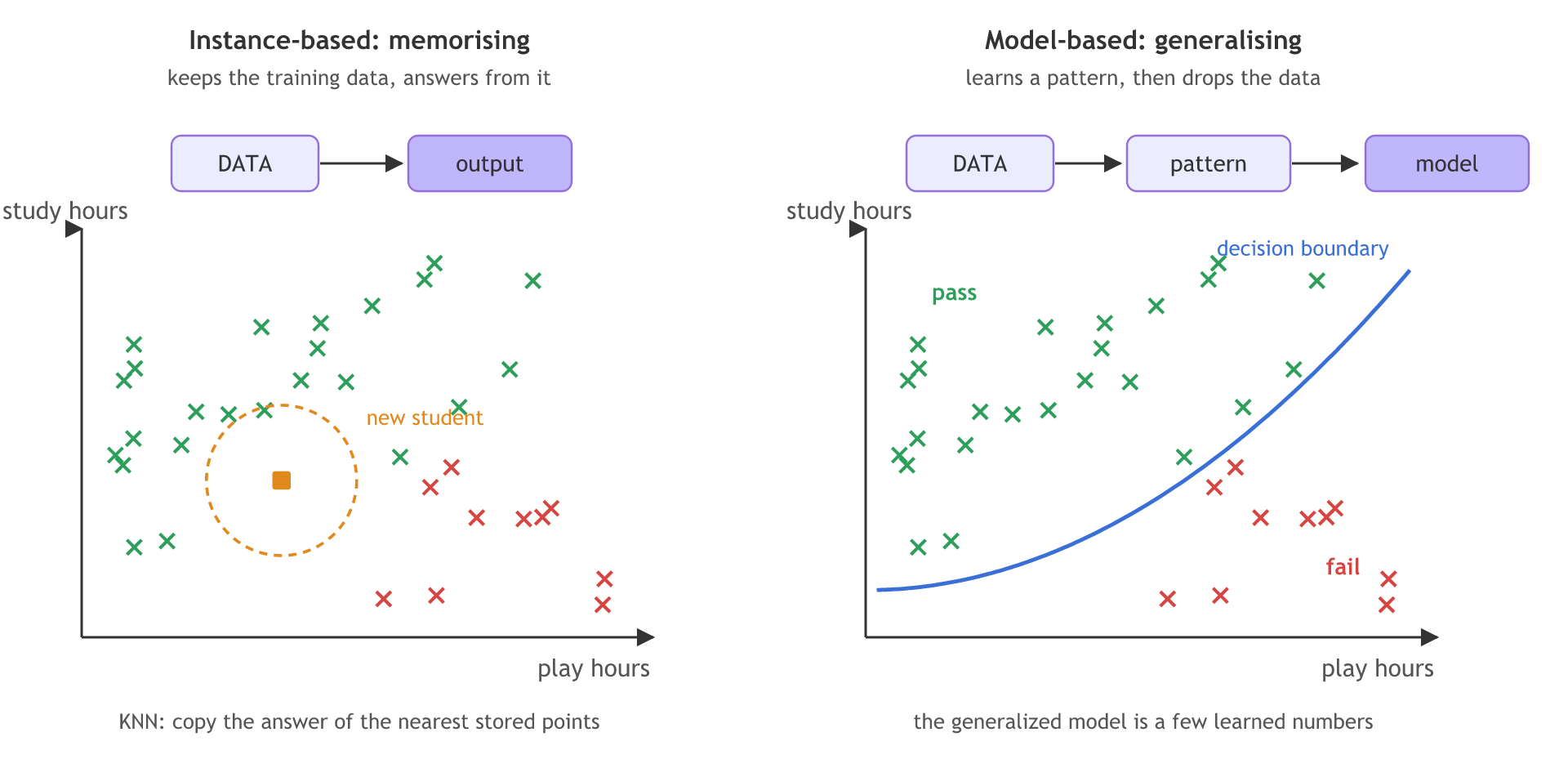
Predicting from the nearest students
The notes' example is a table with the number of play hours, the number of study hours and pass or not. Plot study hours against play hours, each student a cross. A new student arrives: the test point.
Instance-based learning draws a circle around the test point and looks at the training points inside it. If most of those students passed, the answer is pass. Nothing was learned in advance; the comparison happens when the question arrives, and every question needs the stored data. K nearest neighbours (KNN) works this way, and K nearest neighbours (KNN) covers it in full. The notes compare it to a domain expert who answers from the cases they remember.
Drawing a decision boundary
Model-based learning studies the same points once, during training, and learns their pattern: here a curve, the decision boundary, with pass on one side and fail on the other. A new student is placed on one side of the curve and gets that side's answer. Once the boundary is learned, the training rows are no longer needed; the model is the handful of numbers that draw the curve. The straight line of Simple linear regression, with its two numbers θ₀ and θ₁, is a model-based pattern too.
Saving a trained model to disk
The notes then follow what happens after training. The model is saved to the hard drive in a serialized format, such as a pickle (.pkl) file of a few kilobytes or megabytes. Later the saved file is loaded, takes a new input and returns its output. For a model-based model the file holds the learned numbers. An instance-based model has no pattern to save, so its file has to carry the training data, and it grows with every row.
The notes summarise the difference in a table, from preparing the data to scoring a new case:
| Step | Model-based (usual) learning | Instance-based learning |
|---|---|---|
| Preparing the data | Prepare the data for training | The same: no difference here |
| Training | Train a model to estimate its parameters: the pattern is discovered | No training: discovering the pattern waits until a query arrives |
| After training | Store the model; the training data can be thrown away | There is no model to store; the training data must be kept |
| Generalising | Rules are generalised into a model before any new case is seen | No generalisation in advance; each new case is handled as it comes |
| Predicting | Use the model | Use the training data directly, part or all of it |
| Storage | Usually small | Usually large |
| Scoring a new case | Usually fast | Can be slow |
Measuring what each model stores
KNN is instance-based and logistic regression is model-based (a classifier that learns a straight boundary, taught in Logistic regression). Fit both on the same students, then pickle them the way a saved model is written to disk and count the bytes.
The study and play hours data
The video gives no rows for this example, so the students here are generated: a student who studies more than they play usually passes.
import numpy as np

rng = np.random.default_rng(0)

def students(n):
    # study and play hours for n students; more study than play tends to pass
    study, play = rng.uniform(0, 10, n), rng.uniform(0, 10, n)
    passed = (study - play + rng.normal(0, 1, n) > 0).astype(int)   # 1 = pass, 0 = fail
    return np.column_stack([study, play]), passed
Fitting KNN and logistic regression
from sklearn.neighbors import KNeighborsClassifier
from sklearn.linear_model import LogisticRegression

X, y = students(100)
knn = KNeighborsClassifier(n_neighbors=5).fit(X, y)   # instance-based: stores X and y
logreg = LogisticRegression().fit(X, y)                # model-based: learns a boundary
Comparing the saved sizes as the data grows
import pickle

new_student = [[7, 3]]   # 7 study hours, 3 play hours
print("KNN prediction:    ", knn.predict(new_student)[0])
print("logistic prediction:", logreg.predict(new_student)[0])

for n in (100, 10_000):
    X, y = students(n)
    knn_bytes = len(pickle.dumps(KNeighborsClassifier(n_neighbors=5).fit(X, y)))
    log_bytes = len(pickle.dumps(LogisticRegression().fit(X, y)))
    print(f"{n:>6} students: KNN file {knn_bytes:>7} bytes, logistic file {log_bytes} bytes")

print("numbers inside the logistic model:", logreg.coef_.size + logreg.intercept_.size)KNN prediction: 1 logistic prediction: 1 100 students: KNN file 4532 bytes, logistic file 720 bytes 10000 students: KNN file 353884 bytes, logistic file 720 bytes numbers inside the logistic model: 3
Reading the sizes
- Both predict 1, a pass, for 7 study hours and 3 play hours, the notes' passing row. They agree here; they get there differently.
- The KNN file grows with the data. It holds every training row, so 100 times more students makes a file about 80 times bigger, and each prediction compares the new student with the stored rows.
- The logistic file stays the same size. Its pattern is three numbers, two coefficients and an intercept, whether it learned from 100 students or 10,000.
Instance-based vs model-based learning
| Instance-based | Model-based | |
|---|---|---|
| Learns by | Memorising the training data | Generalising it into a pattern |
| Work done at training time | Almost none: store the rows | Most of it: estimate the parameters |
| Work done at prediction time | Compare with the stored rows | Apply the formula |
| Saved model | Grows with the data | A fixed set of numbers |
| Examples in this course | K nearest neighbours | Linear and logistic regression, trees, SVM |
Where you use instance-based and model-based learning
- Instance-based for small tables where similar past cases are the best guide, and new rows keep arriving: adding a row to KNN needs no retraining.
- Model-based for most production systems: a small saved file and fast predictions, such as a pickled regression model behind an app.
- Interviews: "what is the difference between instance-based and model-based learning?" is answered by memorising versus generalising, with KNN as the example.
Related
- Previous: Supervised and unsupervised learning
- Next: Installing scikit-learn
- See also: K nearest neighbours (KNN)
- Notes: Types of ML techniques, instance based vs model based learning
- Change
(100, 10_000)to(100, 100_000): the KNN file grows again and the logistic file does not. - Predict for
[[2, 6]], the notes' failing student, with both models. - Set
n_neighbors=1: KNN now copies the single closest student, the purest form of memorising.
Slow is fine. Stopping is the only problem.